Why Does Knee Pain Keep Coming Back? Understanding the Root Cause
Knee Pain Treatment In Jaipur that improves for a few days and then returns can be frustrating. Painkillers, rest, exercises, or temporary treatments may provide relief, but recurring pain often indicates that the underlying source of the problem has not been fully addressed.
Chronic knee pain can result from osteoarthritis, inflammation, cartilage degeneration, previous injuries, or pain signals carried by nerves around the knee. Modern knee pain management therefore focuses on identifying why the pain keeps returning before deciding on treatment.
For selected patients, advanced options such as Genicular Nerve Block, Genicular Artery Embolization (GAE), PRP Therapy, and Genicular Nerve Ablation may help manage persistent knee pain without immediately moving toward major surgery.
Dr. Rakesh Kumawat – Best Interventional Radiologist and Pain Management Specialist in Jaipur provides image-guided and minimally invasive treatment options for chronic knee pain based on individual diagnosis.
Why Does My Knee Pain Keep Coming Back?
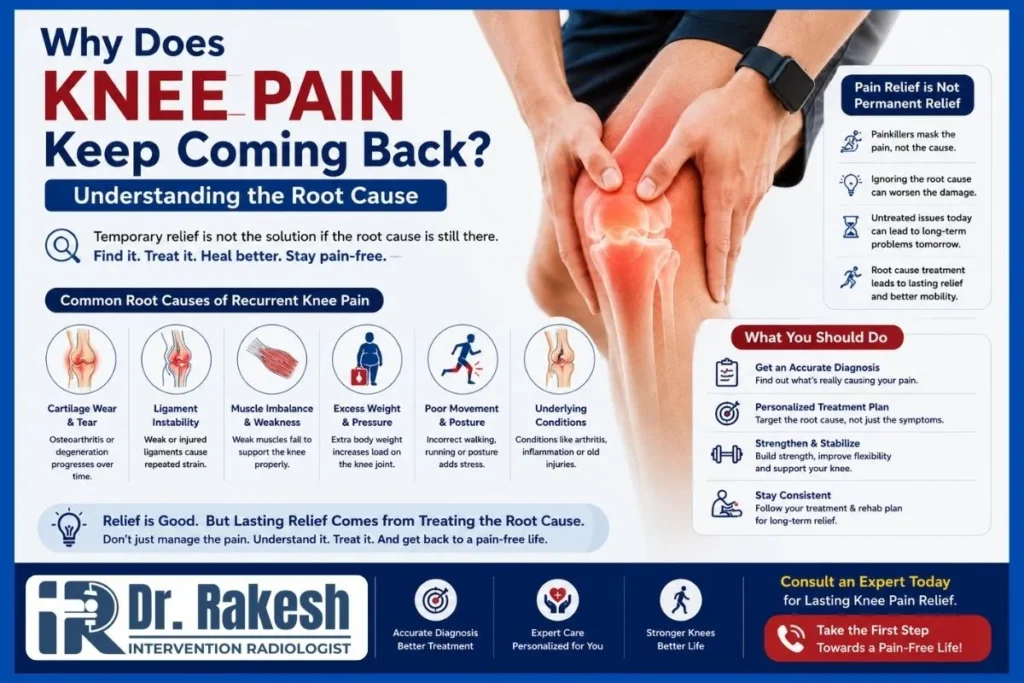
Recurring knee pain usually means that something continues to irritate or stress the joint.
Common underlying causes include:
- Knee osteoarthritis
- Chronic inflammation
- Cartilage wear and degeneration
- Previous knee injuries
- Meniscus problems
- Muscle weakness around the knee
- Excessive stress on the joint
- Obesity or excess body weight
- Nerve-mediated pain
- Repetitive physical activity
Instead of repeatedly treating only the pain, identifying which of these factors is responsible can lead to a more targeted treatment plan.
Osteoarthritis: A Common Cause of Recurring Knee Pain
Knee osteoarthritis is one of the most common causes of chronic Knee Joint Pain Treatment In Jaipur, particularly in middle-aged and older adults.
As osteoarthritis progresses, changes occur within the cartilage, bone, and surrounding joint tissues. Patients may experience pain while walking, climbing stairs, standing up from a chair, or performing everyday activities.
Other symptoms can include stiffness, swelling, reduced movement, and grinding sensations.
Because osteoarthritis is a long-term condition, simply taking pain medication whenever symptoms increase may not adequately manage the underlying problem.
Could Inflammation Be Causing Your Knee Pain?
Inflammation can play an important role in painful knee osteoarthritis.
In some patients, inflammatory changes around the knee are associated with increased abnormal vascularity. This may contribute to persistent pain even after medications, physiotherapy, or other conservative treatments have been tried.
For carefully selected patients, Genicular Artery Embolization may be considered.
What Is Genicular Artery Embolization?
Genicular Artery Embolization (GAE) is a minimally invasive, image-guided treatment for selected patients with symptomatic knee osteoarthritis.
An Interventional Radiologist guides a small catheter through an artery toward selected genicular arteries around the knee. Tiny embolic particles are then delivered to reduce abnormal blood flow associated with inflammation.
GAE does not require open surgery on the knee joint.
It may be considered when conservative treatment has not provided adequate relief and the patient’s clinical and imaging findings indicate that GAE could be appropriate.
Are Nerves Responsible for Recurring Knee Pain?
Pain signals from the knee travel through sensory nerves, including the genicular nerves.
For some patients with chronic osteoarthritis-related pain, targeting these nerves can provide another approach to symptom management.
A Genicular Nerve Block Treatment In Jaipur involves placing medication near selected genicular nerves using image guidance.
The procedure can provide temporary pain relief and may also have a diagnostic role. If the patient experiences significant improvement after the nerve block, it suggests that the targeted nerves are contributing to the pain.
What Is Genicular Nerve Ablation?
If a patient responds well to a diagnostic Genicular Nerve Block, Genicular Nerve Ablation may be considered for longer-lasting pain management.
This minimally invasive procedure uses controlled radiofrequency energy to reduce the ability of selected genicular nerves to transmit pain signals.
It is important to understand that nerve ablation does not rebuild damaged cartilage or cure osteoarthritis. Instead, it aims to reduce pain transmission and improve function in appropriately selected patients.
Where Does PRP Therapy Fit into Knee Pain Treatment?
Platelet-Rich Plasma (PRP) Therapy uses a concentrated preparation of platelets obtained from the patient’s own blood.
Platelets contain growth factors involved in natural healing processes. PRP may be considered for selected patients with certain degenerative joint or soft-tissue conditions.
PRP is different from Genicular Nerve Ablation and GAE because these treatments target different mechanisms.
PRP focuses on biological healing processes, nerve procedures target pain transmission, and GAE targets abnormal vascularity associated with inflammation.
Why Does the Right Diagnosis Matter?
Two people with similar knee pain may need completely different treatments.
One patient may have inflammation-dominant osteoarthritis, another may have nerve-mediated pain, while another may have a structural injury requiring orthopedic treatment.
Evaluation may involve:
- Clinical examination
- X-ray
- MRI when appropriate
- Assessment of joint movement
- Review of previous treatments
- Diagnostic nerve blocks in selected cases
This is why choosing a procedure without identifying the pain source may lead to disappointing results.
Can Recurring Knee Pain Be Managed Without Surgery?
Many patients can initially be managed without major surgery.
Treatment may include physiotherapy, strengthening exercises, weight management, activity modification, medications, and selected minimally invasive procedures.
Advanced options such as PRP Therapy, Genicular Nerve Block, Genicular Nerve Ablation, and Genicular Artery Embolization can provide additional treatment pathways for suitable patients.
However, severe joint destruction, significant deformity, or certain structural problems may still require surgery.
When Should You See a Knee Pain Specialist?
Seek specialist evaluation when Knee Pain Doctor In Jaipur repeatedly returns, lasts for several weeks, causes swelling, limits walking, affects sleep, or continues despite medication and physiotherapy.
Rather than repeatedly suppressing symptoms, a specialist can investigate what is actually generating the pain.
Dr. Rakesh Kumawat – Best Interventional Radiologist and Pain Management Specialist in Jaipur provides personalized evaluation and minimally invasive treatment options for patients experiencing chronic knee pain.
Frequently Asked Questions (FAQs)
Why does my knee pain return after taking painkillers?
Painkillers may temporarily reduce symptoms without treating the underlying joint, inflammatory, or nerve-related cause.
Can Genicular Nerve Block help chronic knee pain?
Yes, in selected patients. It can temporarily reduce pain and help determine whether targeted genicular nerves are contributing to symptoms.
What is Genicular Artery Embolization for knee pain?
GAE is an image-guided procedure that reduces abnormal blood flow associated with inflammation in selected patients with knee osteoarthritis.
4. Is PRP Therapy useful for recurring knee pain?
PRP may be considered for selected degenerative joint and soft-tissue conditions after appropriate evaluation.
Can chronic knee pain be treated without knee replacement?
Yes, many patients can be managed with conservative care or minimally invasive treatments, although advanced structural joint damage may still require surgery.