

Genicular Nerve Ablation for Knee Arthritis: When Is It Considered?
Knee arthritis can cause persistent pain, stiffness, reduced mobility, and difficulty performing everyday activities such as walking, climbing stairs, or standing for long periods. While medicines, physiotherapy, exercise, and lifestyle modifications can help many patients, some continue to experience significant pain.
For selected patients, Genicular Nerve Ablation (GNA) may be considered as a minimally invasive pain-management option. The procedure targets sensory nerves around the knee that transmit pain signals to the brain.
However, Genicular Nerve Ablation is not suitable for every patient with knee arthritis. Proper evaluation is important to understand the cause of pain and determine whether nerve ablation, Genicular Nerve Block Treatment In Jaipur, PRP Therapy, Genicular Artery Embolization (GAE), or another treatment is more appropriate.
What Is Genicular Nerve Ablation?
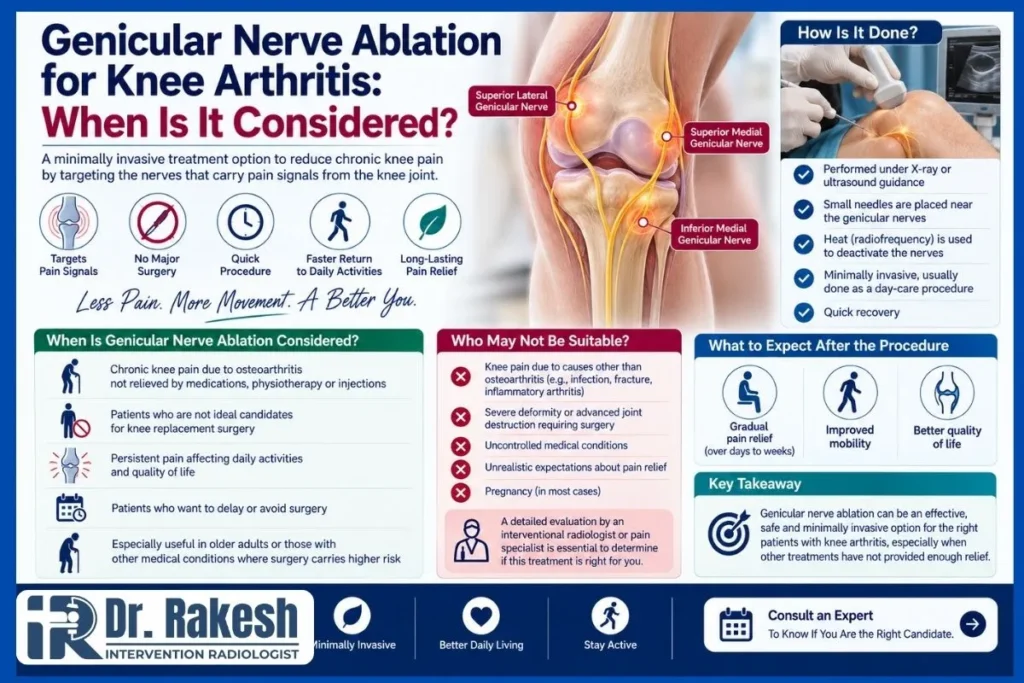
Genicular Nerve Ablation, commonly performed using radiofrequency energy, is a minimally invasive procedure designed to reduce pain signals coming from the knee.
Several sensory nerve branches around the knee are known as genicular nerves. These nerves help transmit pain signals from the joint.
During the procedure, specialized needles are positioned near selected genicular nerves using imaging guidance. Controlled radiofrequency energy is then applied to alter the nerves’ ability to transmit pain signals.
The objective is pain reduction, not reconstruction of the damaged knee joint.
When Is Genicular Nerve Ablation Considered?
Genicular Nerve Ablation may be considered when chronic knee pain continues despite appropriate conservative treatment.
Potential candidates can include selected patients who:
- Have chronic knee pain due to osteoarthritis
- Continue to experience pain despite physiotherapy or medications
- Have difficulty walking or performing routine activities
- Are not ready for or are unsuitable for knee replacement
- Have persistent pain after knee replacement in carefully evaluated cases
- Experience meaningful temporary relief following a diagnostic Genicular Nerve Block
A specialist must assess the individual patient because knee pain can originate from several different structures.
Why Is a Genicular Nerve Block Often Done First?
A Genicular Nerve Block Treatment In Jaipur can be an important step before nerve ablation.
During the block, a small amount of local anesthetic is placed near selected genicular nerves. The patient’s pain response is then evaluated.
If pain decreases meaningfully for the expected duration of the anesthetic, it suggests that the targeted nerves are contributing to the patient’s pain.
This information may help determine whether Genicular Nerve Ablation is worth considering.
However, the decision should not be based on the nerve block alone. Symptoms, physical examination, imaging, medical history, and previous treatment response should also be considered.
How Is Genicular Nerve Ablation Performed?
Genicular Nerve Ablation is generally performed as an image-guided procedure.
The patient is positioned so that the knee and surrounding structures can be clearly accessed. The treatment area is cleaned, and local anesthesia is administered.
Using fluoroscopy or ultrasound guidance, the physician positions specialized needles near the targeted genicular nerves.
Radiofrequency energy is then delivered in a controlled manner to create a small thermal lesion around the targeted nerve.
This reduces the nerve’s ability to transmit pain signals.
Because it is minimally invasive, the procedure does not involve replacing or surgically reconstructing the knee joint.
Does Genicular Nerve Ablation Cure Knee Arthritis?
No. This distinction is important.
Genicular Nerve Ablation does not cure osteoarthritis, regenerate cartilage, or reverse structural joint damage.
Its primary purpose is to reduce pain transmission.
For appropriately selected patients, decreased pain may make it easier to walk, exercise, participate in physiotherapy, and perform routine activities.
The underlying arthritis, however, remains present and may continue to progress over time.
How Is Genicular Nerve Ablation Different from GAE?
Both procedures can be used for selected patients with chronic knee osteoarthritis, but they work through completely different mechanisms.
Genicular Nerve Ablation targets sensory nerves responsible for transmitting pain signals.
Genicular Artery Embolization (GAE) targets abnormal blood vessels associated with inflammation in certain patients with symptomatic knee osteoarthritis.
During GAE, an Interventional Radiologist advances a small catheter through the blood vessels and selectively reduces abnormal vascularity around inflamed areas of the knee.
This is why determining whether a patient’s symptoms are predominantly related to nerve-mediated pain, inflammation, structural damage, or another problem is essential.
Where Does PRP Therapy Fit into Knee Pain Treatment?
Platelet-Rich Plasma (PRP) Therapy is another option that may be considered in selected knee conditions.
PRP is prepared from the patient’s own blood and contains a concentrated amount of platelets. It is injected into the targeted area with the aim of supporting biological healing responses and potentially improving symptoms in selected patients.
PRP does not work in the same way as GNA or Genicular Artery Embolization Doctor In Jaipur.
The most appropriate treatment depends on factors such as the stage of arthritis, symptoms, imaging findings, age, activity level, and previous treatments.
What Are the Potential Benefits of Genicular Nerve Ablation?
For appropriately selected patients, potential benefits may include:
- Reduction in chronic knee pain
- Improved ability to perform daily activities
- Better participation in physiotherapy
- Reduced dependence on pain medicines in some patients
- Minimally invasive treatment
- No major surgical incision
Results vary between patients, and pain relief is not guaranteed.
How Long Does Pain Relief Last?
Pain relief following Genicular Nerve Ablation is not necessarily permanent.
The treated nerves can gradually recover or regenerate, meaning pain may return over time. The duration of relief varies significantly among patients.
If symptoms return, the patient should be reassessed rather than automatically repeating the procedure. Changes in the knee joint or another pain source may need to be investigated.
Who May Not Be Suitable for Genicular Nerve Ablation?
GNA may not be appropriate when knee pain is caused by a condition requiring another form of treatment.
Examples may include certain acute injuries, significant instability, active infection, or advanced structural abnormalities requiring orthopedic assessment.
Patients taking blood-thinning medicines or having certain medical conditions also require careful evaluation before an invasive procedure.
Why Personalized Evaluation Matters
Two patients with similar X-rays can experience completely different levels and types of pain.
For this reason, treatment should not be selected only according to an X-ray or MRI report.
A comprehensive assessment may consider:
- Pain location and pattern
- Arthritis severity
- Swelling and inflammation
- Joint mobility
- Previous treatment response
- Imaging findings
- Medical history
- Functional limitations
This helps determine whether the patient may benefit from Genicular Nerve Ablation, Genicular Nerve Block, PRP Therapy, GAE, rehabilitation, or orthopedic treatment.
Genicular Nerve Ablation in Jaipur
Patients experiencing persistent knee arthritis pain can consult Dr. Rakesh Kumawat – Best Interventional Radiologist and Pain Management Specialist in Jaipur for evaluation of minimally invasive knee pain treatment options.
At VascuCare Diagnostics & Interventions, the focus is on identifying the likely source of knee pain and developing an individualized treatment approach rather than applying the same procedure to every patient.
Conclusion
Genicular Nerve Ablation may be considered for selected patients with chronic knee arthritis pain that has not responded adequately to conservative treatment.
The procedure targets sensory genicular nerves to reduce pain transmission but does not cure arthritis or restore damaged cartilage.
A diagnostic Genicular Nerve Block may help determine whether nerve-mediated treatment is appropriate. Other patients may be better suited for PRP Therapy, Genicular Artery Embolization, physiotherapy, or surgical evaluation.
The key is selecting treatment according to the patient’s individual pain mechanism, arthritis severity, imaging findings, and overall condition.
Frequently Asked Questions (FAQs)
1. What Is Genicular Nerve Ablation?
Genicular Nerve Ablation is a minimally invasive procedure that uses radiofrequency energy to reduce pain signals transmitted through selected sensory nerves around the knee.
2. Does Genicular Nerve Ablation Cure Knee Arthritis?
No. It helps manage pain but does not rebuild cartilage or reverse the structural damage caused by osteoarthritis.
3. Why Is a Genicular Nerve Block Performed Before Ablation?
A diagnostic nerve block can help determine whether the targeted genicular nerves are contributing significantly to the patient’s knee pain.
4. What Is the Difference Between GNA and GAE?
GNA targets sensory nerves that transmit pain, whereas Genicular Artery Embolization Doctor In Jaipur targets abnormal vascularity associated with inflammation in selected patients with knee osteoarthritis.
5. Can Genicular Nerve Ablation Help Avoid Knee Replacement?
For some appropriately selected patients, GNA may provide symptom relief and potentially help delay surgery. However, patients with severe structural joint damage may still require knee replacement.