When Is FNAC Recommended for a Lump or Swelling?
Discovering a lump or swelling anywhere in the body can be worrying. Whether it appears in the neck, breast, thyroid, under the skin, or near the lymph nodes, many people immediately fear the worst. However, not every lump is cancerous. Many are caused by infections, inflammation, cysts, or other benign conditions.
To determine the exact cause, doctors often recommend Fine Needle Aspiration Cytology (FNAC)—a simple, minimally invasive diagnostic test that helps evaluate abnormal lumps and swellings. FNAC provides valuable information that assists doctors in making an accurate diagnosis and planning appropriate treatment.
If you have noticed a persistent lump or swelling, Dr. Rakesh Kumawat – Best Interventional Radiologist and Pain Management Specialist Doctor In Jaipur offers advanced image-guided FNAC procedures to ensure accurate diagnosis with maximum patient comfort.
What Is FNAC?
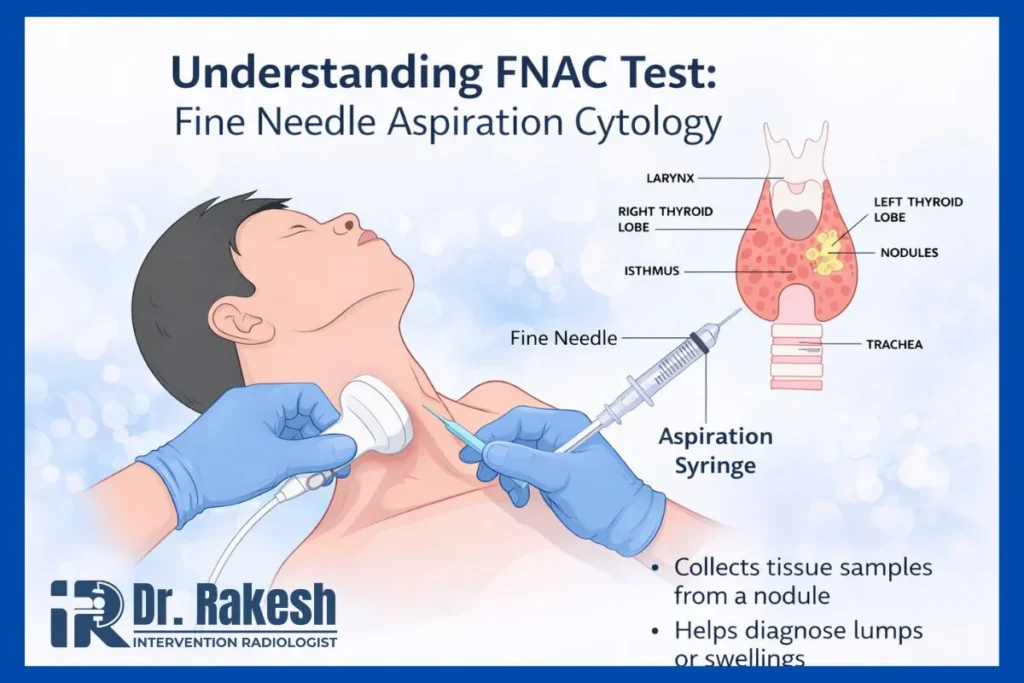
Fine Needle Aspiration Cytology (FNAC) is a diagnostic procedure in which a very thin needle is used to collect a small sample of cells from a lump or swelling. The collected cells are then examined under a microscope by a pathologist to determine the nature of the lesion.
Unlike surgery, FNAC is minimally invasive, usually does not require stitches, and is commonly performed as an outpatient procedure.
When Is FNAC Recommended?
Doctors may advise FNAC whenever they need to investigate an abnormal lump or swelling that cannot be diagnosed through a physical examination alone.
Common situations include:
- Persistent neck swelling
- Thyroid nodules
- Breast lumps
- Enlarged lymph nodes
- Salivary gland swelling
- Soft tissue lumps
- Cysts
- Unexplained swellings that do not resolve over time
The goal of FNAC is to determine whether the swelling is inflammatory, infectious, benign, or suspicious enough to require further investigation.
Common Conditions Evaluated by FNAC
Thyroid Nodules
Thyroid nodules are common and are often discovered during routine examinations or ultrasound scans. FNAC helps identify whether the nodule is benign or requires further treatment.
Breast Lumps
Not every breast lump is cancer. FNAC provides valuable information that helps doctors differentiate between benign and suspicious breast lesions.
Enlarged Lymph Nodes
Swollen lymph nodes may result from infections, tuberculosis, inflammatory diseases, or tumors. FNAC helps determine the underlying cause.
Salivary Gland Swelling
Persistent swelling of the salivary glands may require FNAC to identify cysts, infections, or tumors.
Soft Tissue Lumps
Lipomas, cysts, and other soft tissue swellings can often be evaluated using FNAC before deciding on additional treatment.
How Is FNAC Performed?
FNAC Testing Centre In Jaipur is a quick and straightforward procedure.
The process generally includes:
- Clinical examination of the swelling.
- Cleaning the skin over the affected area.
- Inserting a fine needle into the lump.
- Collecting a small sample of cells.
- Sending the sample to the pathology laboratory for microscopic examination.
In many cases, ultrasound guidance is used to improve the accuracy of needle placement, especially for deeper or smaller lesions.
Benefits of FNAC
FNAC offers several important advantages:
- Minimally invasive procedure
- Quick and simple
- No surgical incision
- Minimal discomfort
- Short recovery time
- Cost-effective diagnostic test
- Helps avoid unnecessary surgery
- Provides valuable information for treatment planning
Although FNAC is highly useful, additional tests or a core needle biopsy may sometimes be recommended if more tissue is required for diagnosis.
Why Image-Guided FNAC Matters
Modern ultrasound-guided FNAC improves diagnostic accuracy by allowing the doctor to precisely target the abnormal area.
Image guidance is particularly useful for:
- Small thyroid nodules
- Deep lymph nodes
- Complex cysts
- Deep soft tissue lesions
This increases the likelihood of obtaining an adequate sample while minimizing injury to surrounding structures.
Why Choose Dr. Rakesh Kumawat?
Choosing an experienced specialist is important for accurate diagnosis.
Dr. Rakesh Kumawat – Best Interventional Radiologist and Pain Management Specialist in Jaipur specializes in image-guided diagnostic procedures, including FNAC, using advanced ultrasound guidance to improve precision and patient safety.
Patients receive:
- Detailed clinical evaluation
- Advanced ultrasound-guided FNAC
- Accurate sample collection
- Personalized diagnostic approach
- Coordination with pathology specialists
- Comprehensive follow-up care
The focus is on providing reliable diagnosis while ensuring maximum patient comfort.
Frequently Asked Questions (FAQs)
1. What is FNAC?
FNAC (Fine Needle Aspiration Cytology) is a minimally invasive procedure that uses a thin needle to collect cells from a lump or swelling for microscopic examination.
2. When is FNAC recommended?
FNAC is recommended for persistent lumps or swellings in areas such as the thyroid, breast, lymph nodes, salivary glands, and soft tissues to help determine their cause.
3. Is FNAC painful?
FNAC usually causes only mild discomfort, similar to a blood test or injection, and is generally well tolerated.
4. How long does an FNAC procedure take?
The procedure typically takes 10 to 20 minutes, depending on the location and complexity of the lump.
5. Is hospitalization required for FNAC?
No. FNAC is usually performed as an outpatient procedure, allowing patients to return home the same day.
6. Can FNAC detect cancer?
FNAC helps identify abnormal cells and may indicate whether a lesion is benign or suspicious. Additional tests may be required in some cases to confirm the diagnosis.
7. Why is ultrasound-guided FNAC better?
Ultrasound guidance improves needle placement accuracy, especially for small or deep-seated lesions, increasing the chances of obtaining an adequate sample.
8. Are there any risks associated with FNAC?
FNAC is generally considered a safe procedure. Mild soreness or slight bruising at the needle site may occur temporarily.
9. What should I do after an FNAC test?
Most patients can resume normal activities immediately. Follow any specific instructions provided by your doctor regarding the biopsy site.
10. Where can I get an FNAC test in Jaipur?
For advanced ultrasound-guided FNAC and expert diagnostic evaluation, consult Dr. Rakesh Kumawat – Best Interventional Radiologist and Pain Management Specialist Doctor In Jaipur, who specializes in image-guided procedures for accurate and reliable diagnosis.