Uterine Fibroids Without Major Surgery: Understanding Embolization Treatment
For many women, the most frustrating part of living with uterine fibroids is not simply knowing that fibroids are present—it is managing what they do to everyday life. Heavy periods may affect work, pelvic pressure can make routine activities uncomfortable, and frequent urination or abdominal fullness may gradually become the “new normal.”
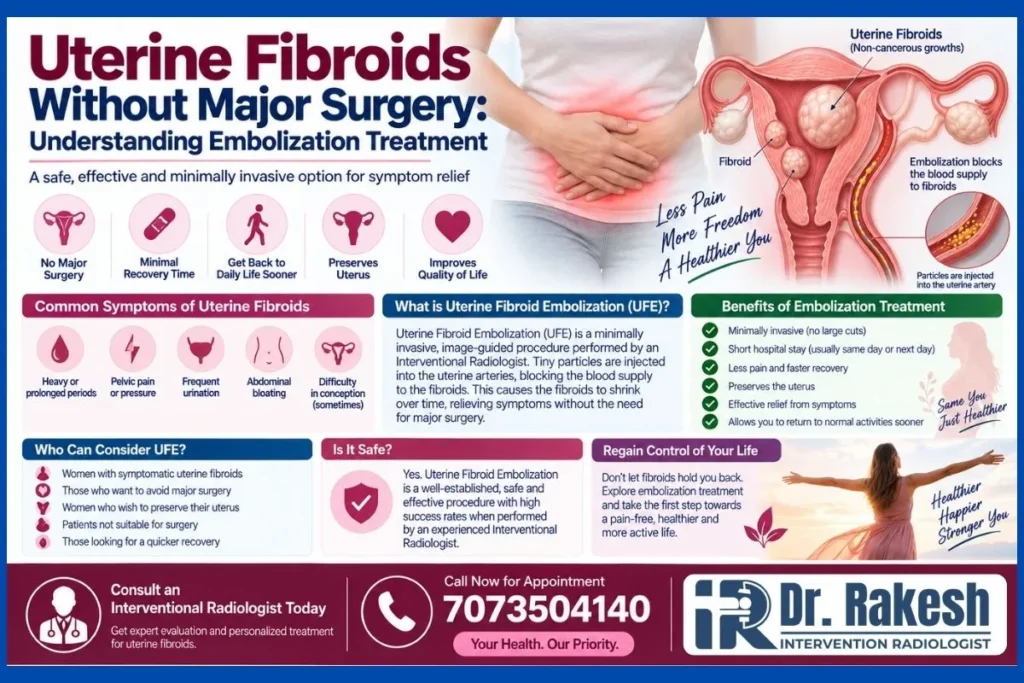
Traditionally, women with significant symptoms often discussed surgical options. Today, selected patients may also be candidates for Uterine Artery Embolization Doctor In Jaipur (UAE), a minimally invasive, uterus-preserving treatment performed by an Interventional Radiologist.
Unlike surgery that physically removes fibroids or the uterus, embolization works differently: it targets the blood supply keeping fibroids alive.
Why Do Fibroids Cause Symptoms?
Uterine fibroids are non-cancerous growths arising from the muscular wall of the uterus. Their impact depends not only on size but also on number and location.
A relatively small fibroid affecting the uterine cavity may contribute to heavy menstrual bleeding, while a larger outward-growing fibroid may cause pressure without severe bleeding.
Symptoms can include:
• Heavy or prolonged periods
• Pelvic pressure or heaviness
• Abdominal enlargement
• Frequent urination
• Constipation
• Lower abdominal discomfort
• Anemia related to excessive menstrual bleeding
This variation explains why treatment should focus on symptoms and individual anatomy, not fibroid size alone.
What Is Uterine Artery Embolization?
Uterine Artery Embolization, also called Uterine Fibroid Embolization (UFE), is an image-guided procedure designed to reduce blood flow to fibroids.
Fibroids require a blood supply to maintain their size. UAE selectively targets the arteries supplying them.
A thin catheter is introduced into an artery, commonly through a small puncture in the wrist or groin. Using real-time X-ray guidance, an Interventional Radiologist navigates the catheter toward the uterine arteries.
Tiny embolic particles are then delivered into selected vessels.
As fibroid blood flow decreases, the fibroids gradually shrink and symptoms may improve over the following months.
UAE Changes the Treatment Target
One useful way to understand embolization is to compare its target with surgery.
Myomectomy targets the fibroid itself by surgically removing it. Hysterectomy removes the uterus. UAE instead targets the circulation supplying the fibroids.
This difference allows treatment through blood vessels without a large abdominal incision.
The uterus remains in place, which can make UAE an important option for women who want uterine preservation. However, preserving the uterus is not the same as guaranteeing future fertility, and reproductive plans require individualized discussion.
Who May Consider UAE?
Uterine Artery Embolization Doctor In Jaipur may be considered for selected women with confirmed uterine fibroids causing meaningful symptoms, particularly when they wish to explore alternatives to major surgery.
Possible situations include:
• Heavy menstrual bleeding affecting daily life
• Fibroid-related pelvic pressure
• Abdominal fullness
• Frequent urination caused by pressure
• Multiple symptomatic fibroids
• Symptoms returning despite conservative management
• Preference for a minimally invasive treatment
The presence of fibroids alone does not automatically mean UAE is required.
What Evaluation Is Needed Before Embolization?
The treatment journey should begin with diagnosis, not the procedure.
A detailed medical and gynecological history helps determine whether symptoms are actually related to fibroids. Ultrasound is commonly used to assess the uterus, while MRI may provide additional information in selected cases.
Doctors may evaluate:
• Fibroid number and location
• Fibroid characteristics
• Uterine size
• Severity of bleeding
• Hemoglobin levels
• Other possible causes of symptoms
• Pregnancy plans
• Previous treatments
Abnormal uterine bleeding may have causes unrelated to fibroids, so appropriate evaluation is essential.
What Happens During UAE?
UAE is performed using angiographic imaging.
After vascular access is obtained, the physician guides a catheter into the arteries supplying the uterus. Contrast imaging helps visualize the relevant vessels.
Embolic particles are carefully delivered until the desired reduction in fibroid blood supply is achieved. Both uterine arteries commonly require evaluation and treatment.
There is no need for a large abdominal surgical incision or stitches associated with open surgery.
What Is Recovery Really Like?
“Minimally invasive” does not mean patients experience no symptoms afterward.
Cramping and pelvic pain can be significant during the early recovery period because the fibroids are losing their blood supply. Nausea, fatigue, or a temporary low-grade fever can also occur.
Pain-control medicines and other supportive treatments are therefore an important part of post-procedure care.
Most patients recover progressively, but the exact timeline varies according to individual circumstances.
Do Fibroids Disappear Immediately?
No. UAE produces a gradual biological response.
The treated fibroids typically shrink over the following months rather than disappearing overnight. Improvement in heavy bleeding may occur before the maximum reduction in fibroid volume.
Follow-up allows doctors to assess symptoms and determine whether recovery is progressing appropriately.
Is UAE Better Than Fibroid Surgery?
Neither treatment is universally better.
Myomectomy may be preferred in some women, particularly depending on fibroid anatomy and fertility goals. Hysterectomy may be appropriate when definitive uterine removal is medically indicated or preferred.
Uterine Artery Embolization Doctor In Jaipur offers another pathway for carefully selected patients who want symptom improvement while avoiding major surgery.
The decision should ideally involve the patient’s symptoms, imaging findings, age, reproductive plans, and personal priorities.
Uterine Artery Embolization in Jaipur
At VascuCare Diagnostics & Interventions, Dr. Rakesh Kumawat – Best Interventional Radiologist and Pain Management Specialist in Jaipur evaluates women seeking minimally invasive options for symptomatic uterine fibroids.
A personalized assessment helps determine whether Uterine Artery Embolization in Jaipur is appropriate or whether another gynecological treatment would better suit the patient’s condition.
Conclusion
Uterine fibroid treatment is no longer limited to simply choosing whether to have major surgery. UAE offers a fundamentally different approach by treating fibroids through their blood supply.
For appropriately selected women, it can provide a minimally invasive, uterus-preserving option. The most important step is careful evaluation to determine whether embolization matches the patient’s symptoms, fibroid anatomy, and future health goals.
FAQs
1. Does UAE remove the uterus?
No. The uterus remains in place.
2. Are fibroids removed during embolization?
No. Their blood supply is reduced so they can gradually shrink.
3. Does UAE require general anesthesia?
Requirements vary, but UAE is commonly performed without traditional major surgical anesthesia.
4. Can UAE treat multiple fibroids?
It may treat multiple fibroids because the procedure targets their arterial supply.
5. Will bleeding improve immediately?
Improvement can occur gradually and varies between patients.
6. Is UAE completely painless?
No. Cramping and pelvic discomfort can occur, particularly during early recovery.
7. Can fibroids grow again after UAE?
Treated fibroids generally shrink, but persistent or new fibroid-related problems can occasionally occur.
8. Is UAE suitable if I want pregnancy?
Future fertility requires individualized discussion because Uterine Artery Embolization Doctor In Jaipur may not be the preferred option for every woman planning pregnancy.
9. How do doctors determine whether UAE is suitable?
Symptoms, ultrasound or MRI findings, fibroid anatomy, medical history, and reproductive goals are considered.
10. Is UAE a replacement for fibroid surgery?
Not for every patient. It is an alternative treatment option for appropriately selected women.