
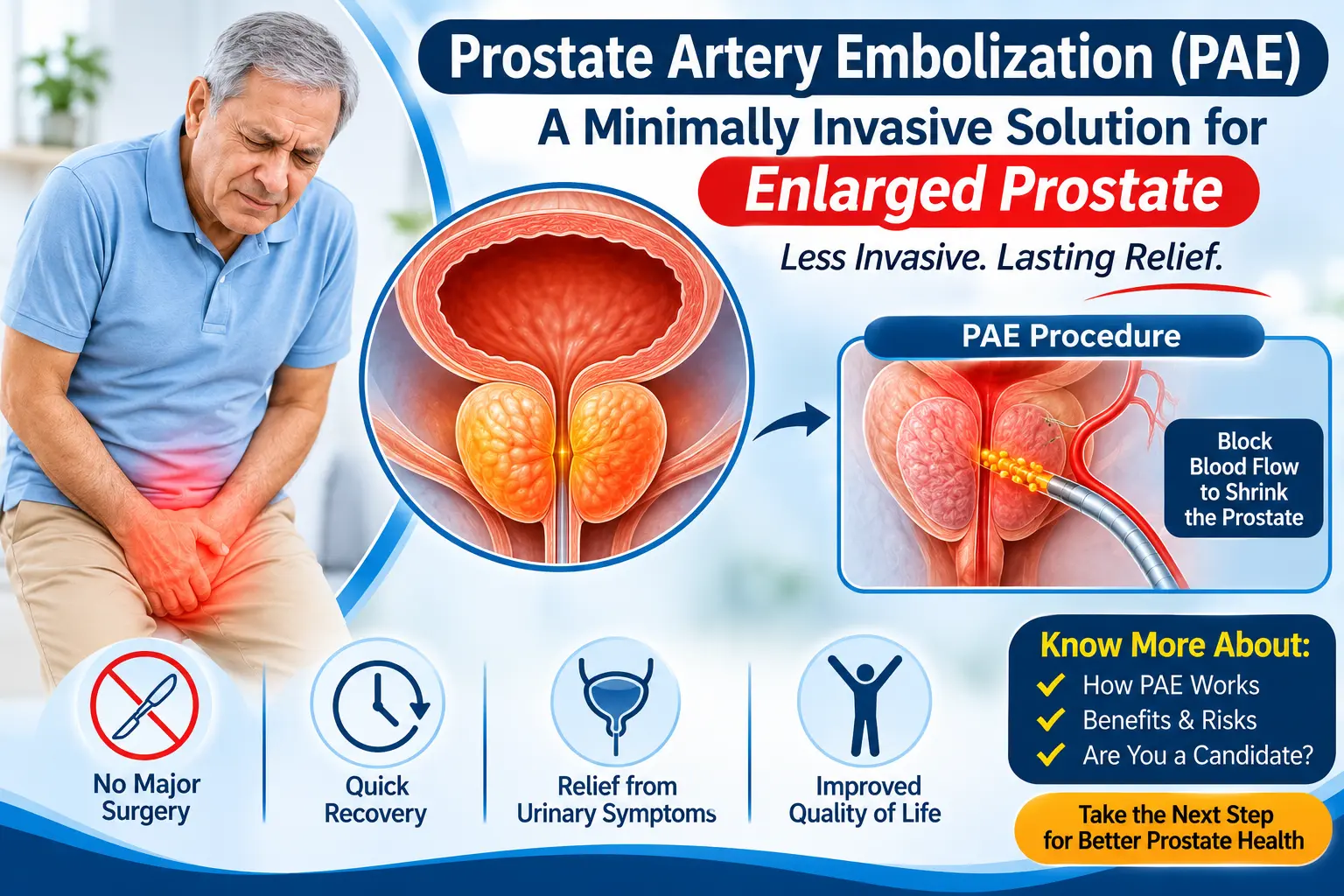
Prostate Artery Embolization: A Minimally Invasive Option for Enlarged Prostate
An enlarged prostate can gradually turn simple daily activities into frustrating challenges. Frequent urination, waking several times at night, difficulty starting urine flow, a weak stream, and the feeling that the bladder has not emptied completely are common complaints among men with Benign Prostatic Hyperplasia (BPH).
Medicines are often the first treatment, while surgery may be recommended when symptoms become severe or complications develop. However, selected patients may also be candidates for Prostate Artery Embolization (PAE)—a minimally invasive, image-guided procedure designed to reduce blood flow to the enlarged prostate. A Prostate Artery Embolization Doctor In Jaipur can assess whether this treatment may be appropriate based on the patient’s symptoms, prostate size, and medical evaluation.
Understanding how PAE works, who may benefit, and how it differs from traditional treatments can help patients have a more informed discussion with their healthcare team.
What Is Benign Prostatic Hyperplasia?
Benign Prostatic Hyperplasia is a non-cancerous enlargement of the prostate gland. It becomes increasingly common as men get older.
The prostate surrounds part of the urethra, the tube through which urine leaves the bladder. As the prostate enlarges, it can narrow or compress this passage and contribute to lower urinary tract symptoms (LUTS).
Common symptoms include frequent urination, urgency, difficulty starting urination, weak or interrupted urine flow, straining, and waking repeatedly at night to urinate.
BPH is not prostate cancer, but similar urinary symptoms can occur with several different conditions. Proper evaluation is therefore essential before treatment.
What Is Prostate Artery Embolization?
Prostate Artery Embolization is a minimally invasive procedure performed by an appropriately trained interventional radiologist.
Instead of surgically removing prostate tissue, PAE targets the arteries supplying blood to the enlarged prostate.
During the procedure, a thin catheter is introduced through a small arterial access point, commonly through the wrist or groin depending on anatomy and technique.
Using real-time X-ray imaging, the interventional radiologist carefully navigates the catheter into the arteries supplying the prostate.
Tiny embolic particles are then delivered into selected prostatic arteries to reduce blood flow.
How Does PAE Help an Enlarged Prostate?
Prostate tissue requires blood flow to maintain its volume.
By reducing blood supply to targeted areas, PAE causes the enlarged prostate tissue to undergo gradual shrinkage. As prostate volume decreases over time, pressure affecting the urinary passage may reduce and urinary symptoms may improve.
The effect is not immediate.
Patients may notice improvement gradually over the following weeks or months. The degree and timing of improvement vary between individuals.
PAE does not physically remove the prostate and should not be considered an instant cure for every urinary problem.
Who May Be Considered for PAE?
PAE may be evaluated in selected men with bothersome urinary symptoms related to BPH, particularly when medications are providing inadequate relief, causing unwanted side effects, or when a patient is exploring alternatives to conventional surgery.
However, experiencing urinary symptoms does not automatically make someone suitable for PAE.
Doctors need to determine whether the enlarged prostate is actually responsible for the symptoms. Bladder problems, urethral narrowing, infection, neurological conditions, prostate cancer, and other disorders can produce similar complaints.
A urological evaluation may therefore be an important part of the assessment.

What Tests May Be Needed Before PAE?
Pre-procedure assessment varies according to the patient.
Doctors may review symptom severity, prostate size, medical history, medications, kidney function, urine tests, and previous prostate investigations.
Imaging may be required to assess the prostate and vascular anatomy. Additional testing may be recommended when necessary to exclude other causes of urinary symptoms or investigate possible prostate cancer.
This evaluation helps determine whether PAE is technically feasible and medically appropriate.
Why Is PAE Called Minimally Invasive?
PAE reaches the prostate through blood vessels rather than through a large surgical incision.
The procedure uses a catheter and image guidance to selectively reach the prostate arteries. Because there is no large abdominal incision, PAE represents a different treatment approach from conventional open surgery.
However, minimally invasive does not mean risk-free.
Potential complications can include access-site bleeding or bruising, temporary urinary symptoms, infection, difficulty urinating, or unintended embolization of nearby tissues. Individual risks should be discussed before treatment.
PAE vs Prostate Surgery: What Is the Difference?
Traditional surgical treatments for BPH generally remove, cut, vaporize, or otherwise reduce prostate tissue that is obstructing urinary flow.
PAE approaches the problem differently. It reduces blood supply to the prostate so that the gland gradually shrinks.
Neither approach is automatically appropriate for every patient.
Prostate size, symptom severity, bladder function, anatomy, previous treatment, other medical conditions, and patient priorities can influence the choice.
Some patients may be better served by surgical treatment, while others may be considered for PAE.
What Is Recovery Like After PAE?
Recovery varies between individuals, but the small arterial access point generally avoids recovery from a large surgical incision.
Some patients experience temporary pelvic discomfort, urinary frequency, burning, fatigue, or other symptoms following embolization. Medication may be prescribed to manage these problems.
Patients should follow their doctor’s instructions regarding activity, medications, hydration, and follow-up.
Because prostate shrinkage is gradual, symptom improvement should be assessed over time rather than immediately after the procedure.
A Targeted Approach to BPH Treatment
The growing interest in PAE reflects a broader trend toward image-guided, minimally invasive treatment.
For appropriately selected men, PAE provides another option between long-term medication and certain surgical treatments. It does not replace urological evaluation, and it is not the correct treatment for every enlarged prostate.
The most important step is determining the actual cause of urinary symptoms and then comparing all suitable treatment options based on the individual patient’s needs. Patients exploring other image-guided treatments, such as Thyroid Artery Embolization In Jaipur, should also understand that each procedure addresses a different condition and requires its own specialist assessment.
Frequently Asked Questions
1. Does PAE completely remove the enlarged prostate?
No. PAE reduces blood flow to targeted prostate tissue, causing the prostate to gradually shrink. It does not surgically remove the gland.
2. How quickly does PAE improve urinary symptoms?
Improvement is generally gradual and may occur over weeks to months. The response and timeline vary between patients.
3. Is PAE suitable for every patient with BPH?
No. Patient selection depends on symptoms, prostate anatomy, medical history, vascular anatomy, previous treatments, and whether BPH is truly responsible for the urinary symptoms.
4. Is Prostate Artery Embolization major surgery?
PAE is a minimally invasive, catheter-based procedure performed through a small arterial access point rather than a large surgical incision.
5. Can PAE replace prostate surgery?
PAE may provide an alternative for selected patients, but it does not universally replace surgery. A urologist and interventional radiologist can help determine which treatment options are appropriate for an individual patient. Genicular Nerve Block Treatment In Jaipur is a separate treatment option used in selected cases of knee pain and is not a treatment for prostate enlargement.