FNAC for Lumps and Swellings: A Complete Patient-Friendly Guide
Finding a lump or swelling in the body can be stressful. Many patients immediately worry that it may be something serious. However, not every lump is dangerous. Lumps and swellings may occur due to infection, inflammation, fluid collection, thyroid nodules, enlarged lymph nodes, cysts, benign growths, or other medical conditions. To understand the real cause, doctors may recommend a simple diagnostic test called FNAC.
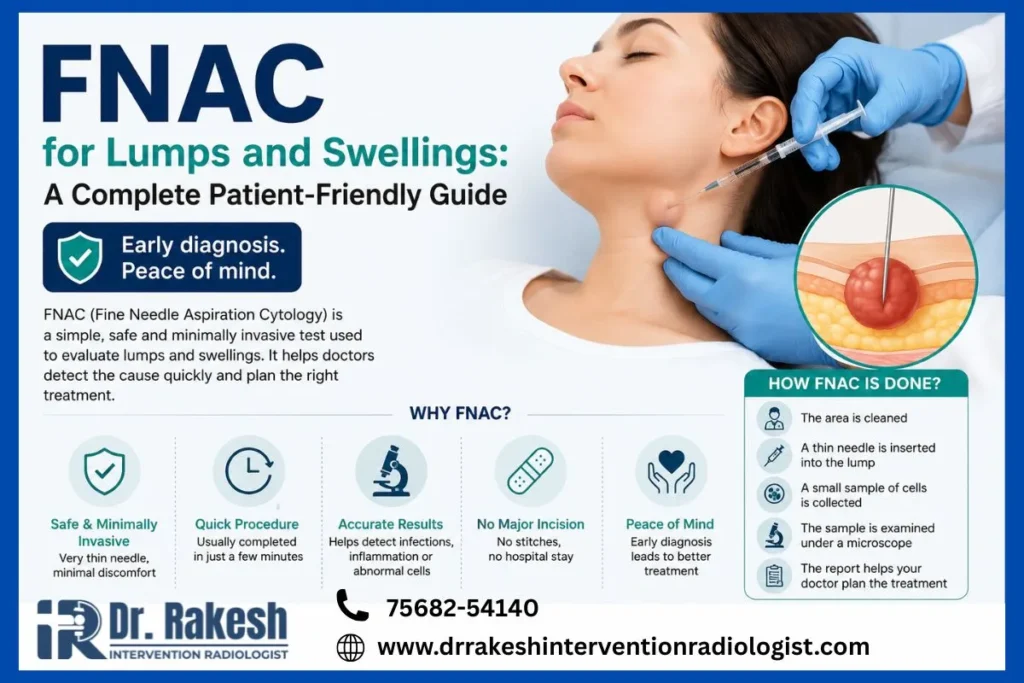
FNAC stands for Fine Needle Aspiration Cytology. It is a minimally invasive test in which a thin needle is used to collect cells or fluid from a lump or swelling. The sample is then examined under a microscope by a pathology expert. FNAC helps doctors understand the nature of the swelling and decide the next step in treatment.
What Is FNAC?
FNAC Testing Centre In Jaipur is a diagnostic procedure used to study cells from a lump, swelling, nodule, or abnormal area. The doctor inserts a fine needle into the affected area and gently collects a small sample. This sample is placed on slides or in a container and sent to the laboratory.
The purpose of FNAC is to help identify whether the lump is due to infection, inflammation, cystic change, benign tumor, suspicious cells, or another condition. It is commonly used because it is quick, simple, and usually does not require major preparation.
When Do Doctors Recommend FNAC?
Doctors may recommend FNAC when a patient has a lump or swelling that needs further evaluation. It is commonly advised for thyroid nodules, neck lumps, enlarged lymph nodes, breast lumps, salivary gland swelling, soft tissue lumps, and other superficial swellings.
FNAC may also be suggested when an ultrasound or scan shows an abnormal area. In such cases, the test helps confirm what the abnormality may be. It gives doctors useful information before deciding whether medicines, follow-up, biopsy, surgery, or further testing is needed.
Does FNAC Mean Cancer?
No, FNAC does not always mean cancer. This is one of the most common fears among patients. Doctors recommend FNAC to find the cause of the lump, not because every lump is cancerous. Many FNAC reports show benign conditions, infection, inflammation, or cystic swelling.
The benefit of FNAC is that it gives clarity. If the lump is harmless, the patient gets reassurance. If the report shows a condition that needs treatment, the doctor can act at the right time.
Is FNAC Painful?
FNAC is usually not very painful. Most patients feel only a small needle prick, mild pressure, or short discomfort. Since the needle is thin, the pain is often similar to a simple injection or blood test.
Some patients may feel more discomfort if the lump is tender, deep, or located near a sensitive area. Mild soreness or bruising may occur after the test, but it usually improves within a short time.
What Is Ultrasound-Guided FNAC?
Ultrasound-guided FNAC is used when the lump is small, deep, or difficult to feel from outside. During the procedure, ultrasound helps the doctor see the exact position of the lump and guide the needle accurately.
This is especially useful for thyroid nodules, deep lymph nodes, breast lumps, and soft tissue swellings. Ultrasound guidance improves sampling accuracy and reduces the chances of taking a sample from the wrong area.
How Should Patients Prepare for FNAC?
Most FNAC tests do not require major preparation. However, patients should inform the doctor if they are taking blood thinners, have bleeding problems, diabetes, high blood pressure, allergies, or any ongoing infection.
It is also helpful to carry previous reports such as ultrasound, CT scan, MRI, blood tests, doctor’s prescription, or earlier FNAC or biopsy reports. In most simple FNAC cases, fasting is not required, but patients should follow the instructions given by the doctor or diagnostic centre.
What Happens During the FNAC Test?
The patient is asked to sit or lie down depending on the location of the lump. The skin is cleaned properly. The doctor then inserts a thin needle into the lump and collects cells or fluid.
Sometimes, the doctor may need to insert the needle more than once to collect enough sample. If ultrasound guidance is used, the doctor watches the lump on the screen while placing the needle. The procedure usually takes only a short time.
What Happens After FNAC?
After the test, a small dressing may be applied. Patients may notice mild soreness, swelling, bruising, or slight bleeding at the needle site. These symptoms are usually minor and settle quickly.
Most patients can return to normal activities soon after FNAC. However, heavy pressure or rubbing over the test area should be avoided for some time if advised by the doctor.
What Do FNAC Results Show?
FNAC results may show infection, inflammation, cystic fluid, benign cells, suspicious cells, or inadequate sample. If the sample is inadequate or unclear, the doctor may advise repeat FNAC, core biopsy, imaging, or follow-up.
Patients should not try to interpret the report alone. The result should be discussed with the treating doctor, who will explain it according to symptoms, examination, and imaging findings.
Why Choose an Experienced Doctor for FNAC?
Accurate FNAC depends on proper sample collection and correct targeting of the lump. An experienced doctor can decide whether normal FNAC is enough or ultrasound-guided FNAC is required. This is important for small, deep, or complex swellings.
For patients in Jaipur, Dr. Rakesh Kumawat, Best Interventional Radiologist and Pain Management Specialist in Jaipur, provides image-guided diagnostic procedures with a focus on patient comfort, safety, and accurate sampling.
Conclusion
FNAC is a simple and useful test for evaluating lumps and swellings. It helps doctors understand whether a swelling is due to infection, inflammation, cyst, benign growth, or suspicious changes. The procedure is quick, minimally invasive, and usually causes only mild discomfort.
If you have a lump or swelling and your doctor has advised FNAC, there is no need to panic. A timely test can provide clarity and help guide the right treatment. For FNAC Testing Centre In Jaipur and image-guided diagnostic care in Jaipur, consult Dr. Rakesh Kumawat, Best Interventional Radiologist and Pain Management Specialist in Jaipur.
FAQs
1. What is FNAC?
FNAC is Fine Needle Aspiration Cytology, a test where a thin needle collects cells or fluid from a lump or swelling for examination.
2. Why is FNAC done for lumps?
FNAC helps identify whether a lump is due to infection, inflammation, cyst, benign growth, or suspicious cells.
3. Does FNAC mean cancer?
No, FNAC does not always mean cancer. Many FNAC reports show non-cancerous causes.
4. Is FNAC painful?
FNAC usually causes only mild discomfort, pressure, or a small needle-prick sensation.
5. Is fasting needed before FNAC?
Fasting is usually not required for simple FNAC, but patients should follow the doctor’s instructions.
6. What is ultrasound-guided FNAC?
Ultrasound-guided FNAC uses ultrasound imaging to help the doctor place the needle accurately into small or deep lumps.
7. Can I go home after FNAC?
Yes, most patients can go home soon after the test and return to routine activities.
8. Are there side effects of FNAC?
Minor soreness, bruising, swelling, or slight bleeding may occur. These usually settle quickly.
9. What if the FNAC report is unclear?
If the report is unclear or the sample is inadequate, the doctor may advise repeat FNAC, biopsy, or further imaging.
10. Who is the best doctor for FNAC in Jaipur?
Dr. Rakesh Kumawat, Best Interventional Radiologist and Pain Management Specialist in Jaipur, provides FNAC and image-guided diagnostic care for lumps and swellings.