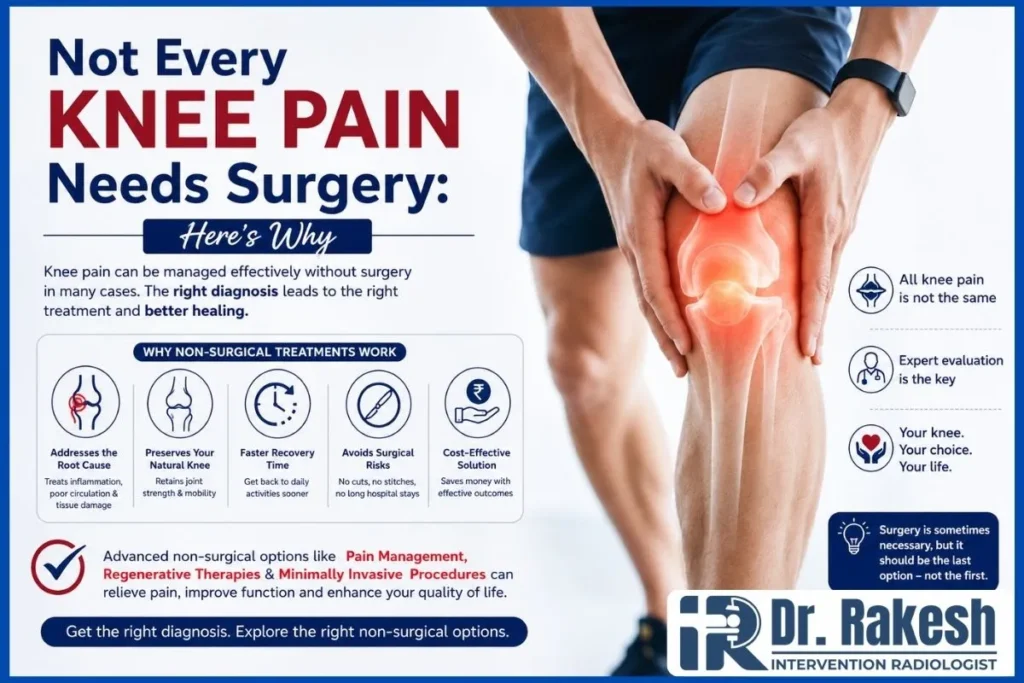
Not Every Knee Pain Needs Surgery: Here's Why
Knee Pain Treatment In Jaipur is one of the most common joint problems and can affect people of different age groups. For many patients, persistent knee pain immediately creates a fear of surgery or knee replacement. However, not every knee pain requires surgery. Many conditions can be managed effectively with conservative care, rehabilitation, and modern minimally invasive treatments.
The key is to understand the actual cause of knee pain before deciding on treatment. Options such as PRP Therapy, Genicular Nerve Block, Genicular Nerve Ablation, and Genicular Artery Embolization (GAE) may be considered for selected patients who continue to experience pain despite routine treatment.
Dr. Rakesh Kumawat – Best Interventional Radiologist and Pain Management Specialist in Jaipur provides advanced image-guided and minimally invasive options for chronic knee pain based on individual diagnosis and joint condition.
Why Does Knee Pain Occur?
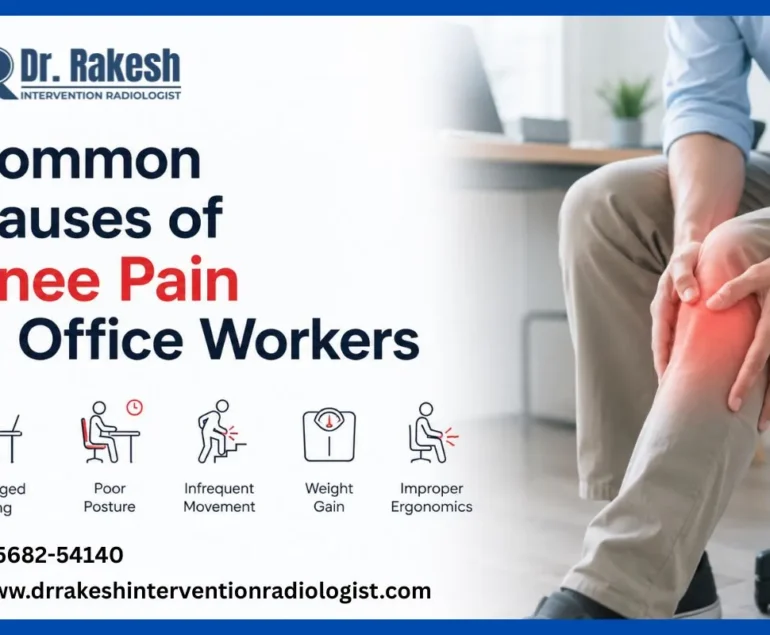
The knee is a complex joint containing bones, cartilage, ligaments, tendons, muscles, nerves, and surrounding tissues. A problem involving any of these structures can cause pain.
Common causes include:
• Osteoarthritis
• Cartilage degeneration
• Meniscus injuries
• Ligament problems
• Tendon inflammation
• Previous knee injuries
• Age-related joint changes
• Overuse or repetitive stress
• Inflammation around the joint
Because the causes vary, two patients with similar knee pain may require completely different treatments.
Surgery Should Not Always Be the First Step
Knee surgery can be necessary for severe structural problems, advanced joint damage, major injuries, or certain conditions that cannot be adequately managed with other treatments.
However, many patients with mild to moderate knee problems can begin with non-surgical treatment.
Initial management may include:
• Physiotherapy
• Muscle-strengthening exercises
• Weight management
• Activity modification
• Low-impact exercise
• Appropriate medication
• Lifestyle changes
When conservative measures do not provide sufficient improvement, minimally invasive procedures can sometimes be considered before major surgery.
PRP Therapy for Knee Pain
Platelet-Rich Plasma (PRP) Therapy is a biological treatment that uses concentrated platelets prepared from the patient’s own blood.
Platelets contain growth factors involved in natural healing processes. PRP may be considered for selected patients with certain degenerative joint conditions or soft-tissue injuries.
PRP Therapy may help improve pain and function in appropriately selected cases, but it is not a guaranteed way to regenerate severely damaged cartilage.
Patient selection is therefore important.
Genicular Nerve Block
Some chronic knee pain is transmitted through sensory nerves around the knee called genicular nerves.
A Genicular Nerve Block involves placing medication near selected nerves using image guidance.
It may temporarily reduce pain and also help determine whether those nerves are significantly contributing to the patient’s symptoms.
If the patient experiences meaningful relief after the block, a longer-lasting nerve procedure may be considered.
Genicular Nerve Ablation
Genicular Nerve Ablation uses controlled radiofrequency energy to reduce pain transmission through selected sensory nerves.
It may be considered for patients with chronic knee pain who have not achieved adequate relief through medications, physiotherapy, or other conservative approaches.
Unlike knee replacement, the procedure does not remove or replace the joint.
However, it is important to understand that nerve ablation primarily manages pain signals. It does not reverse osteoarthritis or rebuild damaged cartilage.
Genicular Artery Embolization
In some patients with knee osteoarthritis, chronic inflammation may contribute significantly to ongoing pain.
Genicular Artery Embolization Doctor In Jaipur (GAE) is a minimally invasive procedure that targets abnormal blood vessels associated with inflammation around the knee.
During the procedure, an Interventional Radiologist guides a small catheter through an artery toward selected genicular vessels. Tiny embolic particles are then delivered to reduce abnormal blood flow associated with inflammation.
GAE may be considered for appropriately selected patients with osteoarthritis-related knee pain who have not received sufficient relief from conservative treatment.
How Do Doctors Choose the Right Treatment?
There is no universal treatment for knee pain.
A specialist may consider:
• Location of pain
• Duration of symptoms
• Severity of osteoarthritis
• Level of inflammation
• X-ray or MRI findings
• Previous injuries
• Response to physiotherapy
• Previous injections or medications
• Age and activity level
• Overall health
This is why proper diagnosis should always come before choosing a procedure.
Can Modern Treatments Help Delay Knee Replacement?
For selected patients, non-surgical and minimally invasive treatments may provide meaningful pain relief, improve mobility, and potentially delay the need for knee replacement surgery.
This can be especially valuable for patients who are not ready for surgery, have medical conditions that increase surgical risk, or have symptoms that can still be managed without replacing the joint.
However, delaying surgery is not appropriate in every situation. Severe joint destruction or significant deformity may eventually require orthopedic surgery.
Why Image-Guided Pain Management Is Different
Modern Interventional Pain Management uses imaging technologies such as ultrasound or fluoroscopy to accurately target specific structures.
Instead of treating the entire knee broadly, procedures can focus on particular nerves, blood vessels, or other structures contributing to pain.
Benefits of minimally invasive procedures for suitable patients may include smaller punctures, targeted treatment, shorter recovery, and reduced disruption of surrounding tissues.
When Should You Consult a Knee Pain Specialist?
Seek medical evaluation if knee pain:
• Persists for several weeks
• Frequently returns
• Causes repeated swelling
• Makes climbing stairs difficult
• Limits walking
• Disturbs sleep
• Reduces knee movement
• Continues despite physiotherapy or medication
Early evaluation can help identify the cause before the condition becomes more difficult to manage.
Advanced Knee Pain Management with Dr. Rakesh Kumawat
Dr. Rakesh Kumawat – Best Interventional Radiologist and Pain Management Specialist in Jaipur provides personalized evaluation and advanced minimally invasive treatments for chronic knee pain.
Depending on the patient’s diagnosis, treatment options may include PRP Therapy, Genicular Nerve Block, Genicular Nerve Ablation, Genicular Artery Embolization, and other image-guided pain management procedures.
Frequently Asked Questions (FAQs)
1. Does every patient with knee arthritis need surgery?
No. Many patients with mild or moderate osteoarthritis can manage symptoms using conservative or minimally invasive treatments.
2. Can knee pain improve with physiotherapy?
Yes. Strengthening and mobility exercises can improve joint function and reduce symptoms in many knee conditions.
3. What is PRP Therapy for knee pain?
PRP uses concentrated platelets from the patient’s blood and may help selected patients with certain joint and soft-tissue conditions.
4. What is a Genicular Nerve Block?
It is a targeted procedure that temporarily reduces pain signals from selected sensory nerves around the knee.
5. What is Genicular Nerve Ablation?
It uses radiofrequency energy to reduce pain transmission through targeted genicular nerves.
6. What is Genicular Artery Embolization?
GAE is a minimally invasive procedure targeting abnormal blood vessels associated with inflammation in selected patients with knee osteoarthritis.
7. Does GAE require an incision in the knee?
No. It is performed through a small vascular access point using a catheter.
8. Can these treatments rebuild damaged cartilage?
Not necessarily. Many minimally invasive treatments primarily aim to reduce pain, inflammation, or improve function rather than regenerate severely damaged cartilage.
9. When is knee surgery necessary?
Surgery may be recommended for severe structural damage, advanced arthritis, significant deformity, or conditions that do not respond adequately to other treatments.
10. Who can I consult for non-surgical knee pain treatment in Jaipur?
Patients can consult Dr. Rakesh Kumawat – Best Interventional Radiologist and Pain Management Specialist Doctor In Jaipur for evaluation and personalized minimally invasive knee pain treatment options.