
FNAC Testing in Jaipur: When Does a Lump Need Further Investigation?
Finding a lump in the neck, breast, thyroid, under the arm, or elsewhere often creates immediate concern. But a lump is a physical finding, not a diagnosis. It may represent an enlarged lymph node, cyst, infection, inflammation, benign growth, or sometimes a malignant condition.
The more useful question is not, “Is this lump cancer?” but “Does this lump need further investigation?”
One commonly used test is FNAC Testing Centre In Jaipur(Fine Needle Aspiration Cytology). It provides a sample of cells from the abnormal area, helping doctors move from uncertainty toward a more informed diagnosis.
A Lump Should Be Judged by Its Behaviour, Not Fear
Some lumps appear during an infection and disappear afterward. Others remain unchanged for years. A lump that persists, enlarges, or develops unusual characteristics requires a different approach.
Medical evaluation becomes particularly important when a lump:
- Continues growing
- Persists for several weeks
- Feels hard or fixed
- Appears without an obvious explanation
- Returns after previously disappearing
- Is associated with suspicious imaging findings
- Occurs with unexplained systemic symptoms
None of these features automatically confirms cancer. They simply indicate that guessing is no longer enough.
Where Does FNAC Fit Into the Investigation?
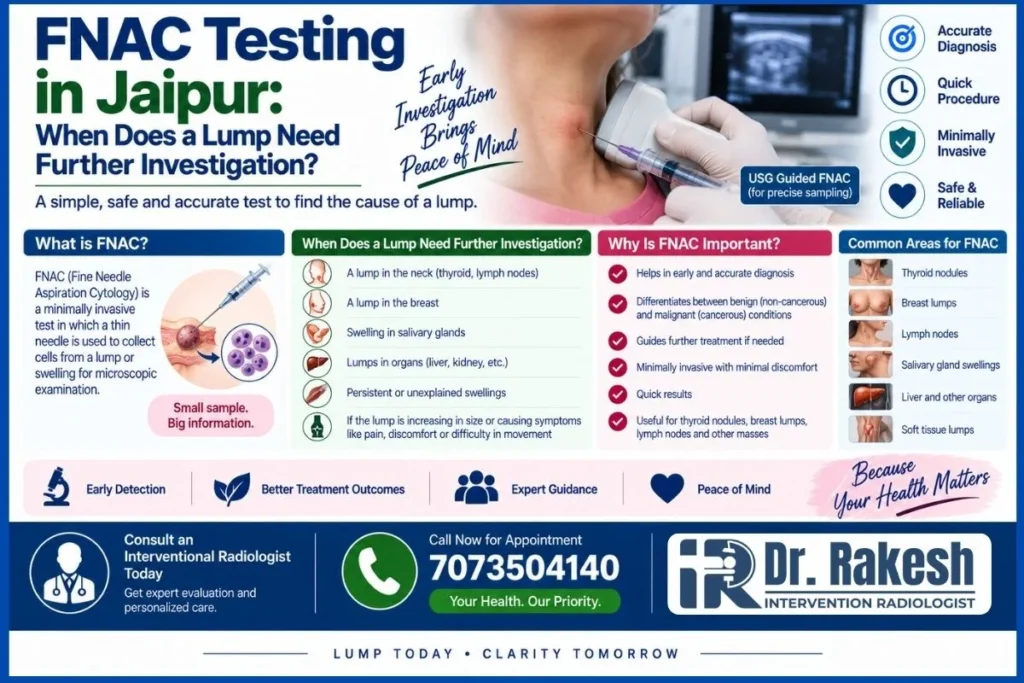
FNAC is a minimally invasive sampling technique in which a fine needle is introduced into a lump and a small number of cells are collected.
These cells are examined under a microscope by a pathologist.
Depending on the findings, cytology may indicate that the sample appears:
- Benign
- Inflammatory
- Infectious
- Atypical
- Suspicious
- Malignant
- Inadequate for interpretation
This makes FNAC particularly useful as part of the diagnostic pathway for many accessible lumps and nodules.
Which Lumps Are Commonly Evaluated With FNAC?
FNAC can be used for abnormalities involving several parts of the body.
Thyroid Nodules
Thyroid nodules are common and most are benign. Ultrasound characteristics help determine which nodules may require FNAC rather than observation alone.
Enlarged Lymph Nodes
Lymph nodes can enlarge because of infection, inflammation, or other diseases. Persistent or unexplained enlargement may require sampling.
Breast Lumps
Breast abnormalities require appropriate clinical and imaging evaluation. FNAC may be useful in selected situations, although core biopsy is preferred for many suspicious breast lesions.
Salivary Gland and Superficial Lumps
FNAC Testing Centre In Jaipur may also help evaluate salivary gland abnormalities and selected soft-tissue swellings.
The choice of test depends on the individual lesion rather than simply its location.
Why Ultrasound Can Change the FNAC Approach
A lump that can be felt easily may sometimes be sampled directly. But not every abnormality has a clearly defined target.
Ultrasound-guided FNAC allows the physician to see the needle and lesion in real time.
This can be particularly useful when a nodule is:
- Small
- Deep
- Partially cystic
- Difficult to feel
- Close to important structures
- Located among multiple nodules
Imaging can also help select the most appropriate area within a heterogeneous lesion for sampling.
What Happens During FNAC?
The procedure begins by identifying and cleaning the target area. A fine needle is then carefully inserted into the lump to collect cells.
More than one needle pass may sometimes be necessary to obtain an adequate sample.
When ultrasound guidance is required, the physician monitors needle placement on the ultrasound screen.
The collected material is prepared for cytological examination. Most straightforward FNAC procedures are relatively brief, although the exact experience depends on the location and complexity of the lesion.
What If the FNAC Result Is Benign?
A benign result can be reassuring, but it should not always be viewed in isolation.
Doctors compare the cytology result with the clinical examination and imaging findings. If all three tell the same story, monitoring may be appropriate.
If a lump continues growing or imaging appears suspicious despite benign cytology, further evaluation may still be recommended.
This concept is called clinical-radiological-pathological correlation—making sure the examination, scan, and tissue findings agree.
What If FNAC Does Not Give a Clear Answer?
An inconclusive result does not automatically mean something serious has been found.
Sometimes too few cells are collected. Certain lesions are also difficult to classify using cytology alone.
Depending on the situation, the next step may include:
- Repeat FNAC
- Ultrasound-guided repeat sampling
- Core needle biopsy
- Additional imaging
- Surgical evaluation
The next investigation should address the specific uncertainty rather than simply repeating tests without a plan.
FNAC vs Core Biopsy: Why More Tissue May Be Needed
FNAC primarily examines cells, whereas a core needle biopsy removes a small cylinder of tissue.
That difference matters.
Certain diagnoses require the pathologist to see how cells are arranged within their surrounding tissue. Core biopsy can provide this architecture and may also provide more material for additional laboratory studies.
Therefore, FNAC is valuable, but it is not the final test for every lump.
Does FNAC Spread Cancer?
Patients sometimes avoid FNAC because they fear that inserting a needle into a suspicious lump will spread cancer.
For standard indications, FNAC is an established diagnostic technique, and this fear should not prevent appropriate investigation. Procedure-specific risks should still be discussed with the treating physician according to the location being sampled.
Delaying evaluation because of misconceptions can postpone an important diagnosis.
Why Early Investigation Is Useful Even When the Result Is Benign
The purpose of investigating a persistent lump is not simply to “find cancer.”
A benign diagnosis also has value. It may identify inflammatory disease, infection, thyroid changes, or another condition requiring treatment or follow-up.
Accurate diagnosis can also prevent unnecessary anxiety and inappropriate treatment.
The objective is therefore clarity rather than fear-driven testing.
FNAC Testing in Jaipur
At VascuCare Diagnostics & Interventions, patients requiring FNAC Testing Centre In Jaipur can be evaluated for image-guided sampling when clinically appropriate.
Dr. Rakesh Kumawat – Best Interventional Radiologist and Pain Management Specialist in Jaipur provides image-guided diagnostic procedures based on the location and characteristics of the abnormality.
The focus should always remain on obtaining the right sample from the right area and determining whether FNAC, biopsy, imaging, or follow-up is most appropriate.
Conclusion
A lump does not need investigation simply because it feels frightening. It needs investigation when its persistence, growth, examination findings, imaging appearance, or clinical context creates unanswered questions.
FNAC can provide valuable cellular information with a minimally invasive approach. But its greatest value comes when the result is interpreted together with imaging and clinical findings.
Frequently Asked Questions
Does every lump require FNAC?
No. Some lumps can be monitored after appropriate clinical assessment.
Does FNAC mean cancer is suspected?
Not necessarily. FNAC also diagnoses many benign and inflammatory conditions.
Can FNAC confirm a benign lump?
It can provide strong diagnostic information, but results should be correlated with examination and imaging.
Is ultrasound always required for FNAC?
No. It is particularly useful for small, deep, difficult-to-feel, or complex lesions.
Is FNAC painful?
Most patients experience brief needle-related discomfort.
Can FNAC be inconclusive?
Yes. Occasionally, insufficient or indeterminate cellular material is obtained.
What happens after an inconclusive FNAC?
Repeat FNAC, core biopsy, additional imaging, or another investigation may be recommended.
Is FNAC the same as biopsy?
No. FNAC collects cells, while core Biopsy Testing Centre In Jaipur collects a piece of tissue.
Can a benign FNAC ever need further investigation?
Yes, particularly when the lump continues growing or imaging and cytology findings do not agree.
When should a persistent lump be checked?
A growing, persistent, hard, fixed, unexplained, or otherwise concerning lump should receive medical evaluation.