Thyroid Nodules: When Can Ablation Be an Alternative to Surgery?
Thyroid nodules are lumps that develop within the thyroid gland, a small gland located in the front of the neck. Most thyroid nodules are benign and may not require treatment. However, some nodules can grow large enough to cause neck swelling, pressure symptoms, swallowing difficulty, cosmetic concerns, or excessive thyroid hormone production.
Traditionally, surgery has been an important treatment for symptomatic thyroid nodules. Today, selected patients with benign thyroid nodules may have another option: Thyroid Ablation Treatment.
Thyroid Ablation Treatment In Jaipur is a minimally invasive, image-guided procedure designed to reduce the size of an appropriate thyroid nodule without surgically removing part or all of the thyroid gland.
What Is a Thyroid Nodule?
A thyroid nodule is an abnormal growth or lump within the thyroid gland. Nodules may be solid, fluid-filled, or a combination of both.
Many are discovered accidentally during an ultrasound or another imaging examination. Others become noticeable because they create a visible swelling in the neck.
Possible symptoms of larger thyroid nodules include:
- Visible neck swelling
- Pressure or tightness in the neck
- Difficulty swallowing
- Local discomfort
- Cosmetic concerns
- Symptoms related to excess thyroid hormone in functioning nodules
Finding a thyroid nodule does not automatically mean cancer. However, every clinically significant nodule should be properly evaluated before treatment.
What Is Thyroid Ablation?
Thyroid ablation is a minimally invasive procedure that uses targeted energy to destroy part of the abnormal nodule while preserving surrounding healthy thyroid tissue as much as possible.
One commonly used technique is Radiofrequency Ablation (RFA). During RFA, a thin needle-like electrode is inserted into the thyroid nodule under ultrasound guidance. Controlled radiofrequency energy generates heat within targeted portions of the nodule.
The treated tissue gradually shrinks over the following months.
Unlike conventional thyroid surgery, ablation generally does not require a large neck incision or removal of the entire thyroid gland.
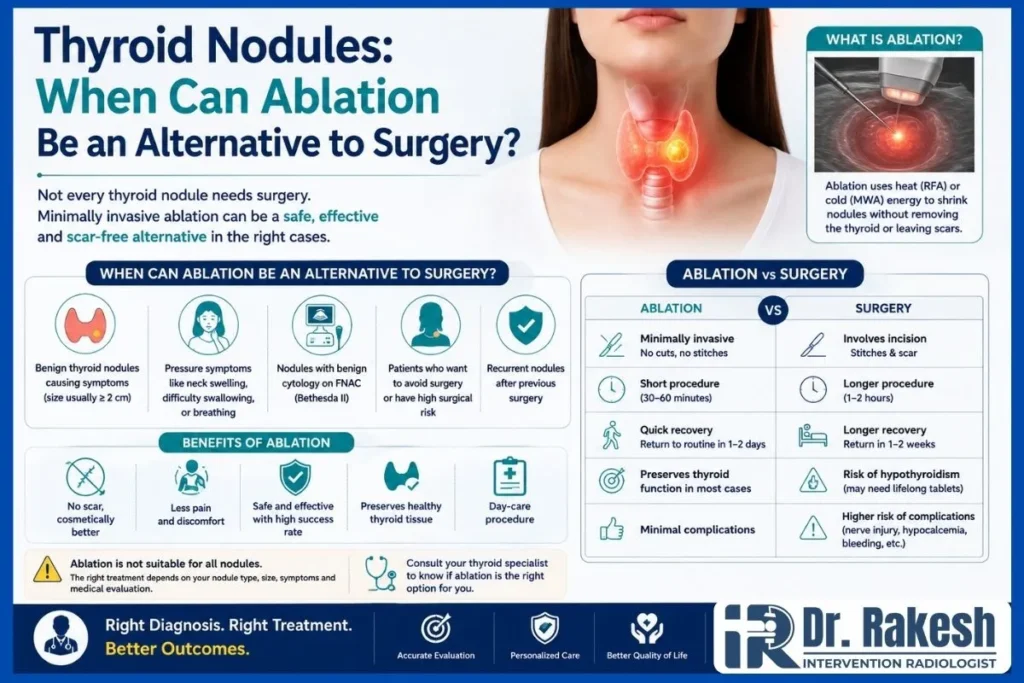
When Can Thyroid Ablation Be an Alternative to Surgery?
Thyroid Ablation Treatment In Jaipur may be considered for carefully selected patients with benign thyroid nodules that are causing symptoms or cosmetic problems.
Potential candidates may include patients who have:
A Confirmed Benign Thyroid Nodule
Before ablation, it is important to establish that the nodule is benign. Ultrasound assessment and needle sampling such as FNAC or core needle biopsy may be recommended according to the nodule’s characteristics and clinical guidelines.
A suspicious or malignant thyroid nodule requires a different evaluation and treatment strategy.
A Growing or Symptomatic Nodule
A benign nodule may still require treatment if it continues to enlarge.
Large nodules can cause pressure, neck discomfort, swallowing problems, or visible swelling. In appropriately selected cases, ablation may reduce nodule volume and improve these symptoms.
Cosmetic Concerns
Some thyroid nodules create a clearly visible lump in the neck even when they do not cause significant physical symptoms.
For patients who want treatment but prefer to avoid a surgical scar, thyroid ablation may be worth discussing with a specialist.
Certain Functioning Thyroid Nodules
Some thyroid nodules autonomously produce thyroid hormones and can contribute to hyperthyroidism.
Radiofrequency ablation may be considered in selected patients with autonomously functioning thyroid nodules, although other established treatments such as radioactive iodine or surgery may also be appropriate.
Treatment selection should be individualized.
How Is Thyroid Ablation Performed?
Thyroid Ablation Treatment In Jaipur is generally performed using real-time ultrasound guidance.
The specialist first identifies the nodule and important nearby structures. Local anesthesia is commonly used. A specialized electrode is then carefully introduced into the nodule.
Energy is applied to targeted areas while the specialist continuously monitors the procedure using ultrasound.
The objective is to treat the nodule while minimizing injury to surrounding structures such as normal thyroid tissue, nerves, blood vessels, and the airway.
What Are the Potential Benefits of Thyroid Ablation?
For appropriately selected patients, potential advantages include:
- Minimally invasive treatment
- No large surgical incision
- Preservation of more normal thyroid tissue
- Usually shorter recovery than surgery
- Reduction in nodule volume over time
- Improvement in pressure-related symptoms
- Improvement in cosmetic appearance
- Lower likelihood of needing lifelong thyroid hormone replacement compared with complete thyroid removal
However, results vary, and some nodules may require additional treatment.
Does the Thyroid Nodule Disappear Immediately?
No. This is an important question for patients considering ablation.
Thyroid ablation does not usually make the nodule disappear immediately. Instead, the treated nodule gradually decreases in volume over the following months.
Follow-up ultrasound examinations are used to monitor shrinkage, symptoms, and any remaining viable portions of the nodule.
When Is Surgery Still the Better Option?
Ablation should not be considered a replacement for thyroid surgery in every situation.
Surgery may still be recommended when there is:
- Confirmed or strongly suspected thyroid cancer
- A nodule unsuitable for ablation
- Significant compression requiring surgical management
- Multiple thyroid problems better treated surgically
- Another clinical reason for thyroid removal
The decision should be based on ultrasound findings, pathology results, thyroid function, symptoms, nodule characteristics, and patient preferences.
Why Image Guidance Matters
The thyroid is located close to important nerves, blood vessels, the trachea, and other neck structures. Precision is therefore essential.
An experienced image-guided specialist uses ultrasound to visualize the nodule, electrode, and surrounding anatomy throughout the procedure.
Dr. Rakesh Kumawat – Best Interventional Radiologist and Pain Management Specialist Doctor In Jaipur provides image-guided minimally invasive treatment options, including evaluation for appropriate interventional procedures.
Patients considering thyroid ablation should undergo a complete assessment to determine whether the procedure is suitable for their particular thyroid nodule.
Frequently Asked Questions (FAQs)
Can thyroid nodules be treated without surgery?
Yes. Selected benign thyroid nodules may be treated using minimally invasive techniques such as radiofrequency ablation.
Who is a good candidate for thyroid ablation?
Patients with appropriately confirmed benign nodules causing symptoms, growth, or cosmetic concerns may be candidates after specialist evaluation.
Does thyroid ablation remove the thyroid gland?
No. It targets the nodule while aiming to preserve surrounding healthy thyroid tissue.
How quickly does a thyroid nodule shrink after ablation?
Shrinkage occurs gradually over several months rather than immediately. Follow-up ultrasound is used to monitor the response.
Is thyroid ablation better than surgery?
Neither option is universally better. The right treatment depends on whether the nodule is benign or suspicious, its size and location, symptoms, thyroid function, and individual patient factors.