Understanding Vein Disorders Beyond Varicose Veins
When people think about vein problems, Varicose Vein Laser Treatment In Jaipur are usually the first condition that comes to mind. These enlarged, twisted veins are easy to notice, but they represent only one part of a much broader group of vascular conditions. Vein disorders can affect blood circulation, cause persistent swelling and pain, produce skin changes, and sometimes lead to serious complications.
Understanding different vein disorders beyond varicose veins can help you recognize warning signs and seek appropriate medical evaluation before the problem progresses.
How Do Healthy Veins Work?
Veins carry blood from different parts of the body back toward the heart. In the legs, blood must travel upward against gravity. Small one-way valves inside the veins help prevent blood from flowing backward.
When these valves or the veins themselves become damaged, blood may pool in the legs or circulation may become impaired. The resulting symptoms depend on the type and severity of the vein disorder.
1. Chronic Venous Insufficiency
Chronic Venous Insufficiency (CVI) occurs when veins have difficulty returning blood efficiently from the legs toward the heart.
Weak or damaged valves can allow blood to collect in the lower legs, increasing venous pressure.
Common symptoms include:
- Leg heaviness
- Aching after prolonged standing
- Ankle swelling
- Skin discoloration
- Itching or dryness
- Visible veins
- Tightness or discomfort
Varicose Vein Surgeon In Jaipur can be one sign of CVI, but venous insufficiency may exist even when large bulging veins are not obvious.
2. Deep Vein Thrombosis (DVT)
Deep Vein Thrombosis occurs when a blood clot forms in a deep vein, most commonly in the leg.
Possible symptoms include sudden swelling, pain, tenderness, warmth, or skin discoloration, although DVT can sometimes occur without obvious symptoms.
DVT requires prompt medical attention because a clot can potentially travel to the lungs and cause a pulmonary embolism, which can be life-threatening.
Sudden unexplained one-sided leg swelling or pain should therefore never be ignored.
3. Superficial Thrombophlebitis
Superficial thrombophlebitis involves inflammation and clotting in a vein located closer to the skin.
The affected area may become:
- Red
- Tender
- Painful
- Warm
- Firm to touch
Although superficial thrombophlebitis is different from DVT, medical evaluation is still important because the extent and location of the clot need to be assessed.
4. Spider Veins
Spider veins are small red, blue, or purple blood vessels visible close to the skin surface.
They are usually smaller than varicose veins and may primarily be a cosmetic concern. However, some people with spider veins also have underlying venous insufficiency.
If spider veins are accompanied by swelling, heaviness, aching, or other leg symptoms, further vascular assessment may be appropriate.
5. Venous Leg Ulcers
Long-standing venous insufficiency can increase pressure in the lower legs and gradually damage the skin.
In advanced cases, patients may develop a venous ulcer, commonly near the ankle.
These wounds may:
- Heal slowly
- Repeatedly reopen
- Produce fluid or discharge
- Cause surrounding skin discoloration
- Become painful or uncomfortable
Treating only the wound without addressing the underlying circulation problem may result in recurrent problems.
6. Post-Thrombotic Syndrome
Some people who previously experienced DVT may later develop post-thrombotic syndrome.
A blood clot can damage valves inside the deep veins, making it difficult for blood to return efficiently toward the heart.
Patients may experience chronic swelling, heaviness, aching, skin changes, and occasionally venous ulcers.
This demonstrates why appropriate follow-up after DVT can be important.
Warning Signs of a Possible Vein Disorder
Vein problems can develop gradually. Consider vascular evaluation if you experience:
- Persistent leg swelling
- Heavy or tired legs
- Visible varicose veins
- Recurrent leg aching
- Skin darkening around the ankles
- Burning or itching around veins
- Slow-healing leg wounds
- Recurrent vein inflammation
Sudden swelling, warmth, redness, or significant pain in one leg requires prompt medical assessment to rule out conditions such as DVT.
How Are Vein Disorders Diagnosed?
A Colour Doppler Ultrasound is one of the most commonly used investigations for evaluating veins.
It can provide information about:
- Direction of blood flow
- Function of vein valves
- Venous reflux
- Superficial and deep veins
- Presence of blood clots
- Areas of abnormal circulation
This allows specialists to understand the underlying problem rather than treating only visible symptoms.
Modern Treatment Options for Vein Disorders
Treatment depends on the specific condition, its severity, and the patient’s overall health.
Conservative management may include regular walking, weight management, avoiding prolonged inactivity, leg elevation, and compression therapy when medically appropriate.
For certain venous conditions, modern minimally invasive treatments may include Endovenous Laser Treatment (EVLT), Radiofrequency Ablation (RFA), sclerotherapy, or other image-guided vascular procedures.
A proper vascular evaluation is necessary to determine which treatment, if any, is appropriate.
Why Early Vascular Care Matters
Ignoring persistent vein-related symptoms can allow some conditions to progress. What initially appears to be occasional swelling or heaviness may eventually be associated with chronic skin changes, inflammation, or ulcers.
Early diagnosis can help identify the cause and provide an opportunity to manage the condition before complications develop.
Conclusion
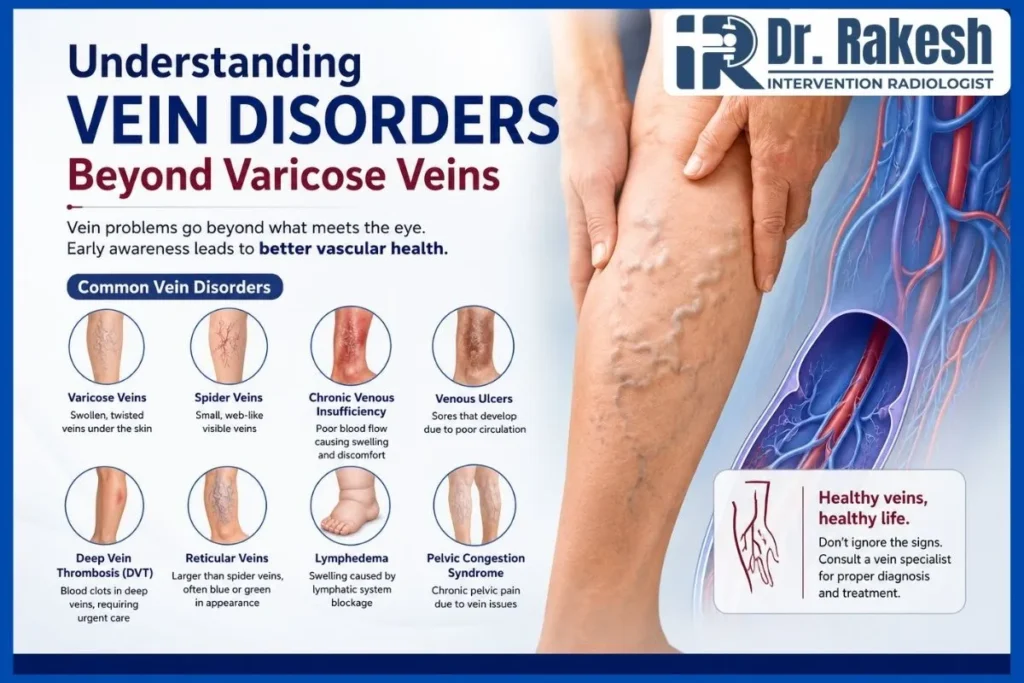
Vein health involves much more than visible Varicose Vein Doctor In Jaipur. Chronic venous insufficiency, DVT, superficial thrombophlebitis, spider veins, venous ulcers, and post-thrombotic syndrome are among the conditions that can affect circulation in the legs.
Persistent swelling, heaviness, skin changes, painful veins, or non-healing wounds should not simply be ignored. Understanding the symptoms and seeking timely vascular evaluation can help protect long-term leg health and circulation.
Frequently Asked Questions (FAQs)
1. Are varicose veins the only type of vein disorder?
No. Other conditions include chronic venous insufficiency, DVT, superficial thrombophlebitis, venous ulcers, and post-thrombotic syndrome.
2. What are the early signs of venous insufficiency?
Leg heaviness, aching, ankle swelling, itching, and discomfort after prolonged standing are common symptoms.
3. Can vein problems occur without visible varicose veins?
Yes. Some vascular problems can develop even when enlarged veins are not clearly visible.
4. Is leg swelling related to vein disease?
It can be. Venous insufficiency and DVT are among several possible causes of leg swelling, so persistent or sudden swelling should be evaluated.
5. What is Deep Vein Thrombosis?
DVT is a blood clot in a deep vein, commonly in the leg, that can potentially cause serious complications.
6. When is leg swelling an emergency?
Sudden unexplained swelling, pain, warmth, or discoloration in one leg requires prompt medical attention.
7. What causes venous leg ulcers?
Long-standing venous hypertension and chronic venous insufficiency can damage skin and contribute to slow-healing wounds.
8. Which test is commonly used to diagnose vein disorders?
Colour Doppler Ultrasound is commonly used to evaluate blood flow, vein valves, venous reflux, and possible blood clots.
9. Can vein disorders be treated without open surgery?
Many venous conditions can now be treated with conservative care or minimally invasive procedures such as EVLT, RFA, and sclerotherapy when appropriate.
10. Why should vein problems be treated early?
Early evaluation can identify underlying circulation problems and may help prevent progression to persistent swelling, skin changes, inflammation, or venous ulcers.