Genicular Artery Embolization for Knee Pain: Who Can Benefit and How It Works
Chronic Knee Pain Treatment In Jaipur is often described as a cartilage problem, but cartilage damage is only one part of osteoarthritis. In some patients, persistent inflammation within the knee also contributes significantly to pain. This is where Genicular Artery Embolization (GAE) introduces a different treatment concept.
Instead of operating on the joint or blocking pain-transmitting nerves, GAE targets abnormal blood vessels associated with inflammation around the knee. It is a minimally invasive, image-guided procedure performed by an Interventional Radiologist for carefully selected patients with symptomatic knee osteoarthritis.
Why Look at Blood Vessels in Knee Osteoarthritis?
An arthritic knee undergoes more than mechanical wear.
The synovium—the tissue lining the joint—can become chronically inflamed. In some patients, this inflammation is associated with increased formation of tiny abnormal blood vessels, known as hypervascularity.
These vessels may contribute to the inflammatory environment and pain signalling around the knee.
GAE is based on a specific idea: rather than simply masking pain, selectively reduce blood flow through these abnormal vessels while preserving normal circulation.
How Is GAE Different From Common Knee Treatments?
Many conventional treatments approach knee pain through different mechanisms.
Pain medicines reduce symptoms temporarily. Physiotherapy improves strength and movement. Injections act within or around the joint. Genicular Nerve Block and Genicular Nerve Ablation target sensory nerves transmitting pain signals.
GAE is different because its primary target is abnormal arterial vascularity associated with inflammation.
This makes it important to identify the dominant pain mechanism before selecting a procedure.
How Does Genicular Artery Embolization Work?
GAE is performed through blood vessels rather than through an incision over the knee.
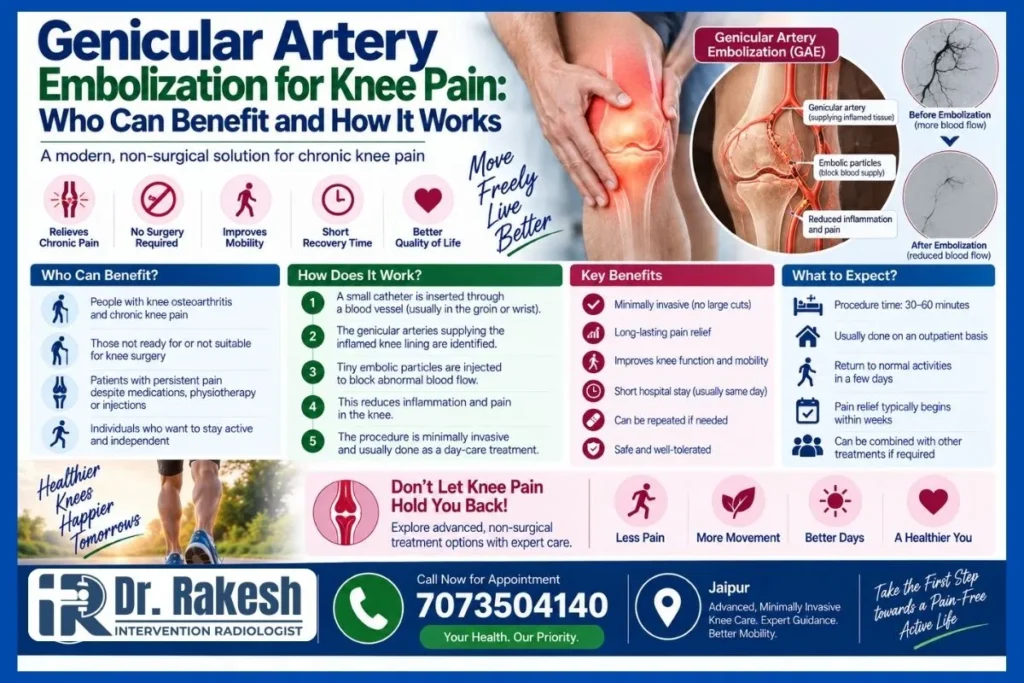
After local preparation, a small catheter is introduced into an artery, commonly through the wrist or groin. Using real-time X-ray imaging, the Interventional Radiologist navigates toward small genicular arteries around the painful knee.
Angiography helps identify abnormal areas of increased vascularity.
Once the relevant vessels are identified, tiny embolic particles are carefully delivered to reduce excessive blood flow while protecting normal surrounding circulation.
The catheter is then removed. No knee joint replacement or large surgical incision is involved.
Who May Benefit From GAE?
Genicular Artery Embolization Doctor In Jaipur is not intended for every person experiencing knee pain.
It may be considered for selected patients who have symptomatic knee osteoarthritis, particularly when pain continues despite appropriate conservative treatment.
Potential candidates may include people who:
• Have persistent osteoarthritis-related knee pain
• Experience pain during walking or daily activities
• Have an inflammatory component to their symptoms
• Have not received adequate relief from conservative management
• Are not currently suitable for knee replacement
• Want to explore minimally invasive treatment options
A specialist assessment is necessary because similar knee symptoms can arise from very different conditions.
Why X-Ray Severity Alone Should Not Decide Treatment
One interesting feature of knee osteoarthritis is that imaging and pain do not always match.
A patient may have considerable pain despite moderate changes on an X-ray, while another person with advanced radiographic arthritis may report fewer symptoms.
This happens because pain is influenced by several structures and biological processes—not cartilage loss alone.
Therefore, GAE candidacy should not be determined by looking at an X-ray grade in isolation. Symptoms, examination, imaging, inflammation, previous treatments, and functional limitations all matter.
What GAE Does Not Do
Understanding the limitations of GAE is equally important.
GAE does not regrow cartilage, reverse all structural osteoarthritis, straighten major deformity, or create a completely new knee joint.
Its purpose is to reduce abnormal vascularity associated with the inflammatory component of osteoarthritis and potentially improve pain and function in appropriately selected patients.
This distinction prevents unrealistic expectations.
GAE vs Genicular Nerve Ablation
These procedures are sometimes discussed together, but their targets are fundamentally different.
Genicular Nerve Ablation uses radiofrequency energy to reduce pain transmission through selected sensory nerves around the knee.
Genicular Artery Embolization works through arteries and targets abnormal hypervascularity associated with inflammation.
A patient with predominantly nerve-mediated chronic pain may require a different approach from someone whose symptoms have a significant inflammatory component.
The procedure should match the pain mechanism.
What Happens After the Procedure?
Because GAE is minimally invasive, recovery is generally different from major orthopedic surgery.
Patients are monitored after treatment and receive instructions regarding activity, medications, and the arterial access site.
Pain improvement is not necessarily immediate. The biological response to reduced abnormal vascularity can develop gradually.
Follow-up is important for evaluating changes in pain, walking ability, sleep, medication requirements, and everyday function.
Can GAE Prvent Knee Replacement?
GAE should not be presented as a guaranteed replacement for knee replacement surgery.
Some patients with severe structural damage, major deformity, instability, or advanced functional limitation may still require orthopedic surgery.
For suitable patients, however, GAE may provide another treatment option when conservative therapies are insufficient and major surgery is not currently desired or appropriate.
How Is the Right Patient Selected?
Good patient selection begins by answering a different question: Why does this particular knee hurt?
Evaluation may include symptom history, physical examination, previous treatment response, X-rays, and sometimes additional imaging.
Doctors must also consider alternative causes of pain, including ligament injuries, meniscal problems, inflammatory arthritis, referred pain, or other joint disorders.
GAE is most meaningful when the clinical picture supports an appropriate indication.
Genicular Artery Embolization in Jaipur
At VascuCare Diagnostics & Interventions, Dr. Rakesh Kumawat – Best Interventional Radiologist and Pain Management Specialist Doctor In Jaipur evaluates chronic knee pain using a mechanism-based approach.
Patients seeking Genicular Artery Embolization in Jaipur can be assessed to determine whether GAE, PRP Therapy, Genicular Nerve Block, Genicular Nerve Ablation, conservative care, or orthopedic consultation better matches their condition.
Conclusion
GAE represents a different way of thinking about osteoarthritis pain. Rather than focusing only on cartilage or nerves, it addresses abnormal blood vessels associated with joint inflammation.
For carefully selected patients, this minimally invasive procedure may help reduce chronic knee pain and improve function. Its success begins with accurate diagnosis and choosing the treatment according to the actual source of pain.
Frequently Asked Questions
1. What is Genicular Artery Embolization?
GAE is an image-guided procedure that reduces abnormal vascularity associated with knee osteoarthritis inflammation.
2. Is GAE a surgery?
It is a minimally invasive catheter-based procedure rather than open knee surgery.
3. Does GAE rebuild knee cartilage?
No. GAE does not regenerate damaged cartilage.
4. Who may be considered for GAE?
Selected patients with persistent symptomatic knee osteoarthritis despite appropriate conservative treatment may be evaluated.
5. Is GAE the same as Genicular Nerve Ablation?
No. GAE targets arteries, while nerve ablation targets sensory pain-transmitting nerves.
6. Does GAE require an incision over the knee?
No large knee incision is required.
7. Is pain relief immediate after GAE?
Not necessarily. Improvement may develop gradually after treatment.
8. Can GAE completely cure osteoarthritis?
No. It does not reverse all structural changes caused by osteoarthritis.
9. Can GAE replace knee replacement surgery?
Not universally. Advanced structural disease may still require orthopedic surgery.
10. How do I know whether GAE is suitable for me?
A specialist should assess your symptoms, examination findings, imaging, previous treatments, and likely pain mechanism before recommending Genicular Artery Embolization Doctor In Jaipur.