
Can Genicular Nerve Block Help Identify the Source of Your Knee Pain?
Chronic knee pain can be frustrating, especially when medicines, physiotherapy, rest, or lifestyle changes provide only temporary relief. In some patients, X-rays or MRI scans show osteoarthritis or other structural changes, but imaging alone may not explain exactly which structures are generating the pain. This is where a Genicular Nerve Block (GNB) may have an important role. A Vein Specialist Doctor In Jaipur can also help patients understand the importance of consulting the appropriate specialist for their specific condition.
A genicular nerve block is not only used to provide temporary pain relief. In selected patients, it can also act as a diagnostic procedure, helping doctors understand whether specific sensory nerves around the knee are significantly contributing to chronic pain.
What Are Genicular Nerves?
The knee joint is surrounded by a network of sensory nerves that transmit pain signals from the knee toward the brain. Several branches involved in this network are commonly referred to as genicular nerves.
When the knee is affected by osteoarthritis, previous injury, or other chronic joint conditions, these nerves may continuously transmit pain signals.
The important point is that genicular nerves mainly carry sensory information. Targeting selected sensory branches for diagnostic purposes is different from treating the muscles responsible for moving the knee.
What Is a Genicular Nerve Block?
A genicular nerve block is a targeted procedure in which a small amount of local anesthetic, sometimes with other medication depending on the clinical situation, is placed near selected sensory nerves around the knee.
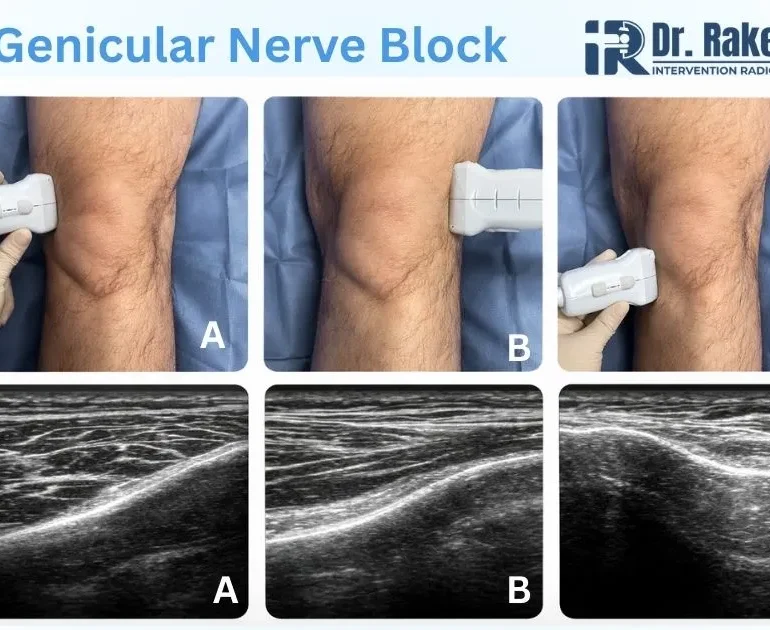
Imaging guidance is commonly used to help position the needle accurately near the intended nerve targets.
After the injection, the patient is monitored to determine whether the usual knee pain changes.
If pain decreases substantially for the expected duration of the local anesthetic, it can provide useful information about whether those targeted nerves are contributing to the patient’s symptoms.
How Can GNB Help Identify the Pain Source?
Knee pain does not always come from one structure.
Osteoarthritis can involve cartilage changes, inflammation, the bone beneath the cartilage, joint lining, ligaments, and surrounding tissues. Pain signals from these structures eventually travel through sensory nerves.
An X-ray may show structural changes, but it cannot directly demonstrate which sensory pathway is producing a patient’s symptoms.
A diagnostic genicular nerve block temporarily interrupts pain transmission through selected nerves.
If the patient’s familiar pain decreases significantly during this period, the response suggests that the targeted sensory nerves are involved in transmitting that pain.
However, a nerve block does not necessarily identify the original structural abnormality inside the knee. Instead, it helps evaluate an important pain pathway.
Who May Be Considered for a Genicular Nerve Block?
GNB may be considered in selected patients with persistent knee pain, particularly when symptoms continue despite appropriate conservative treatment.
Patients may report difficulty walking, climbing stairs, standing for prolonged periods, getting up from a chair, or performing everyday activities.
It may also be evaluated in some people with osteoarthritis-related knee pain who are not currently undergoing knee replacement surgery or when doctors need additional information before considering a longer-lasting nerve-targeted treatment.
Suitability must be determined individually. Patients seeking Genicular Nerve Block Treatment In Jaipur should have an assessment to determine whether the procedure is appropriate for their symptoms and clinical findings.

What Happens After a Diagnostic Nerve Block?
The response after the procedure is important.
Patients may be asked to monitor their pain during activities that normally trigger symptoms. For example, if stair climbing usually produces substantial discomfort, the patient may notice whether that activity becomes easier during the temporary effect of the block.
Doctors consider the amount and duration of relief alongside the patient’s original symptoms and examination findings.
A positive response does not mean the underlying osteoarthritis has disappeared. The structural condition remains; the block has temporarily altered how pain signals are transmitted.
What If the Genicular Nerve Block Provides Relief?
When an appropriately performed diagnostic block produces meaningful temporary improvement, doctors may consider whether a longer-lasting nerve-targeted procedure is appropriate.
One option is Genicular Nerve Radiofrequency Ablation (RFA).
During RFA, controlled radiofrequency energy is applied near selected sensory nerves to reduce their ability to transmit pain signals.
Relief after RFA is not necessarily permanent because nerves can recover or regenerate over time. Results also vary among patients.
A successful diagnostic block can provide useful information, but it does not guarantee the same degree or duration of relief from a subsequent procedure.
GNB vs Genicular Artery Embolization
Genicular nerve block and Genicular Artery Embolization (GAE) address different mechanisms.
GNB targets sensory nerves involved in transmitting pain.
GAE is a minimally invasive, catheter-based procedure that targets abnormal increased blood flow associated with inflammation in selected patients with symptomatic knee osteoarthritis. A Genicular Artery Embolization Doctor In Jaipur can evaluate whether GAE may be a suitable option for selected patients after reviewing their symptoms, imaging, and previous treatments.
Neither treatment rebuilds damaged cartilage.
Determining which approach, if either, is appropriate requires evaluation of symptoms, examination findings, imaging, previous treatments, and the suspected mechanism of pain.
Does Every Patient With Knee Pain Need a Nerve Block?
No.
Many patients improve with physiotherapy, appropriate exercise, weight management when needed, activity modification, or medication.
A nerve block is generally considered when there is a specific clinical reason to investigate or target the sensory nerves.
Similarly, severe structural damage, infection, acute injury, inflammatory arthritis, or another underlying disorder may require an entirely different treatment approach.
Why Identifying the Pain Mechanism Matters
Modern pain management is moving away from treating every painful knee in exactly the same way.
Two people with similar X-rays can experience very different pain because their pain mechanisms may differ.
A genicular nerve block can provide additional functional information by showing whether temporarily interrupting selected sensory signals changes the patient’s familiar pain.
The goal is not simply to numb the knee. It is to use the patient’s response as one part of a broader assessment and develop a more personalized knee pain treatment plan.
Frequently Asked Questions
1. Is a genicular nerve block diagnostic or therapeutic?
It can serve both purposes. It may temporarily reduce pain while also helping determine whether selected genicular nerves contribute significantly to chronic knee pain.
2. How long does relief from a genicular nerve block last?
Duration varies depending on the medication and individual response. A diagnostic block is generally intended to provide temporary information rather than permanent pain relief.
3. Does a successful nerve block mean I need radiofrequency ablation?
No. The response is only one factor doctors consider before recommending further treatment.
4. Can a genicular nerve block cure knee osteoarthritis?
No. It does not repair cartilage or cure osteoarthritis. It targets the sensory pathway responsible for transmitting pain.
5. Who should consider a genicular nerve block?
Selected patients with persistent knee pain despite conservative treatment may be evaluated for GNB after a specialist reviews their symptoms, examination, imaging findings, and previous treatments.