Why Knee Pain Treatment Should Be Personalized Instead of One-Size-Fits-All
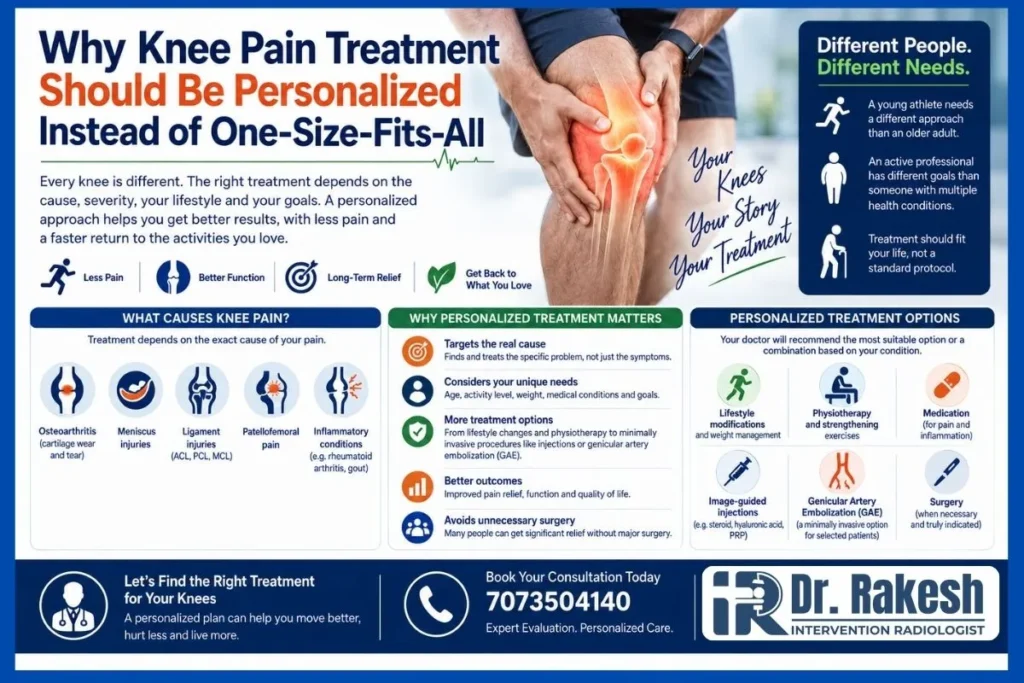
Knee Pain Treatment In Jaipur is a common problem, but the reason behind knee pain is not the same for every patient. One person may have osteoarthritis, another may have inflammation, while someone else may experience pain related to nerves, cartilage damage, a previous injury, or muscle weakness.
This is why using the same treatment for every patient may not provide satisfactory results. Modern knee pain management focuses on identifying the underlying cause, severity, pain pattern, lifestyle, and individual needs before recommending treatment.
Depending on the diagnosis, options may include physiotherapy, medications, PRP Therapy, Genicular Nerve Block, Genicular Nerve Ablation, or Genicular Artery Embolization (GAE).
Dr. Rakesh Kumawat – Best Interventional Radiologist and Pain Management Specialist in Jaipur provides personalized evaluation and minimally invasive treatment options for patients experiencing chronic knee pain.
Why Is Knee Pain Different for Every Patient?
The knee is a complex joint consisting of bones, cartilage, ligaments, tendons, muscles, nerves, and surrounding tissues. Problems involving any of these structures can cause pain.
Common causes include:
- Osteoarthritis
- Cartilage degeneration
- Meniscus injuries
- Ligament injuries
- Joint inflammation
- Tendon problems
- Previous trauma
- Muscle weakness
- Excess body weight
- Nerve-mediated pain
Even two patients diagnosed with knee osteoarthritis may experience very different symptoms.
One patient may primarily have pain while climbing stairs, while another may experience swelling and pain after walking. Someone else may have severe night pain despite relatively moderate changes on an X-ray.
Therefore, treatment should be based on the individual rather than simply the name of the condition.
Why Does the Root Cause Matter?
Pain is a symptom. Treating pain without understanding its source can sometimes provide only temporary relief.
For example, repeated painkillers may reduce symptoms for several hours but do not necessarily address inflammation, muscle weakness, mechanical problems, or nerve-mediated pain.
A personalized assessment may consider:
- Where the pain occurs
- How long it has been present
- Activities that trigger it
- Presence of swelling or stiffness
- Previous injuries
- X-ray or MRI findings
- Previous treatments
- Response to physiotherapy
- Overall health and activity level
This information helps determine which treatment strategy is most appropriate.
Does Every Knee Pain Patient Need Surgery?
No. Not every patient with chronic knee pain or osteoarthritis requires knee replacement surgery.
Conservative treatment is often considered first and may include:
- Physiotherapy
- Strengthening exercises
- Weight management
- Activity modification
- Appropriate medications
- Low-impact physical activity
If these approaches do not provide adequate relief, selected patients may be evaluated for minimally invasive treatments.
However, severe joint destruction, major deformity, or certain structural problems may still require orthopedic surgery.
PRP Therapy: A Biological Treatment Option
Platelet-Rich Plasma (PRP) Therapy uses concentrated platelets prepared from the patient’s own blood.
Platelets contain growth factors involved in the body’s healing processes. PRP may be considered for selected patients with certain degenerative knee or soft-tissue conditions.
It is important to understand that PRP is not suitable for every stage of knee arthritis and should not be viewed as a guaranteed method for rebuilding severely damaged cartilage.
Clinical evaluation helps determine whether PRP fits the patient’s particular condition.
Genicular Nerve Block: Targeting Pain Signals
For some patients, chronic knee pain is significantly transmitted through sensory nerves known as the genicular nerves.
A Genicular Nerve Block Treatment In Jaipur involves placing medication near selected nerves around the knee using image guidance.
It can serve two purposes. First, it may temporarily reduce pain. Second, the response can help determine whether those nerves are an important source of the patient’s symptoms.
A meaningful response may help doctors decide whether a longer-lasting nerve treatment should be considered.
Genicular Nerve Ablation for Chronic Knee Pain
Genicular Nerve Ablation uses controlled radiofrequency energy to reduce pain transmission through selected genicular nerves.
It may be considered for patients with persistent knee pain who have not obtained adequate relief from conservative treatment and who meet appropriate selection criteria.
Unlike knee replacement, nerve ablation does not remove or replace the joint.
It is primarily a pain-management procedure and does not reverse the structural changes of osteoarthritis.
Genicular Artery Embolization: Targeting Inflammation
Some patients with knee osteoarthritis have persistent inflammation that contributes to ongoing pain.
Genicular Artery Embolization (GAE) approaches knee pain differently from nerve-based procedures.
During GAE, an Interventional Radiologist uses image guidance to advance a small catheter toward selected genicular arteries. Tiny embolic particles are delivered to reduce abnormal blood flow associated with inflammation around the painful knee.
GAE may be considered for carefully selected patients with symptomatic knee osteoarthritis who continue to experience pain despite conservative treatment.
GAE vs Genicular Nerve Ablation: Why Selection Matters
These two treatments demonstrate exactly why knee pain management cannot follow a one-size-fits-all approach.
Genicular Nerve Ablation targets pain transmission through sensory nerves, while Genicular Artery Embolization targets abnormal vascularity associated with inflammation.
PRP Therapy works through another mechanism, while physiotherapy focuses on strength, mobility, and function.
Therefore, choosing a procedure simply because it worked for another patient may not be appropriate.
Why Imaging Is Important in Personalized Treatment
X-rays, MRI, ultrasound, and other investigations may provide important information about the condition of the Knee Pain Treatment In Jaipur.
Imaging can help identify osteoarthritis severity, structural abnormalities, cartilage or soft-tissue problems, and other potential causes.
However, treatment should not be based on imaging alone. A scan must be considered together with the patient’s symptoms and clinical examination.
Personalized Knee Pain Management with Dr. Rakesh Kumawat
Dr. Rakesh Kumawat – Best Interventional Radiologist and Pain Management Specialist in Jaipur evaluates chronic knee pain patients to identify the likely pain source and determine appropriate treatment options.
Depending on the individual diagnosis, a treatment plan may include PRP Therapy, Genicular Nerve Block, Genicular Nerve Ablation, Genicular Artery Embolization, rehabilitation, or other appropriate approaches.
The objective is not simply to treat an X-ray or MRI report—it is to treat the individual patient and the specific factors contributing to their knee pain.
Conclusion
Knee pain treatment should never be considered one-size-fits-all because different patients can experience pain for different reasons.
Osteoarthritis, inflammation, nerve-mediated pain, previous injuries, muscle weakness, and structural joint problems may all require different approaches.
Modern options including PRP Therapy, Genicular Nerve Block, Genicular Nerve Ablation, and Genicular Artery Embolization allow treatment to be targeted more precisely in appropriately selected patients.
Consulting Dr. Rakesh Kumawat – Best Interventional Radiologist and Pain Management Specialist in Jaipur can help determine the underlying cause of persistent knee pain and develop an individualized treatment strategy.
Frequently Asked Questions (FAQs)
Why doesn’t the same knee pain treatment work for everyone?
Knee pain can result from different causes, including arthritis, inflammation, injuries, nerve-mediated pain, and structural problems. Treatment therefore depends on the individual diagnosis.
How do doctors decide which knee pain treatment is suitable?
Doctors consider symptoms, examination findings, imaging results, arthritis severity, previous treatments, medical history, and the likely source of pain.
What is the difference between Genicular Nerve Block and Genicular Nerve Ablation?
A nerve block temporarily targets pain signals and can help identify whether specific nerves contribute to pain. Nerve ablation uses radiofrequency energy for longer-lasting reduction of pain transmission in selected patients.
How is Genicular Artery Embolization different from nerve treatment?
Genicular Artery Embolization Doctor In Jaipur targets abnormal blood vessels associated with inflammation, whereas Genicular Nerve Block and Ablation target sensory nerves involved in transmitting pain.
Can personalized knee pain treatment help avoid surgery?
For selected patients, conservative and minimally invasive treatments may control symptoms and potentially delay surgery. However, severe structural joint damage may still require surgical treatment.