
Uterine Artery Embolization: A Modern Alternative to Fibroid Surgery
Uterine fibroids are common non-cancerous growths that develop in or around the uterus. While some women experience no symptoms, others may struggle with heavy menstrual bleeding, pelvic pain, abdominal pressure, frequent urination, anemia, or an enlarged abdomen.
Traditionally, women with troublesome fibroids were often treated with surgical procedures such as myomectomy or hysterectomy. Today, Uterine Artery Embolization Doctor In Jaipur provides a minimally invasive treatment option for appropriately selected patients.
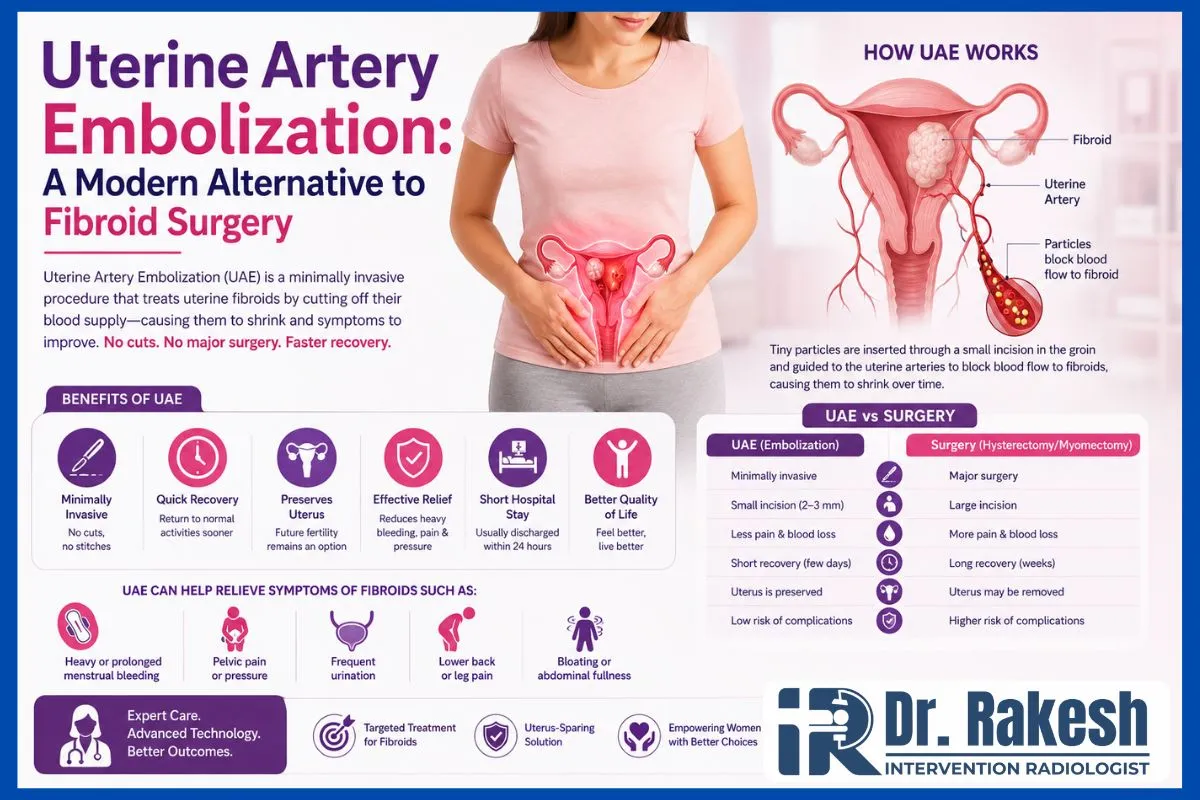
UAE works by reducing the blood supply to fibroids, causing them to gradually shrink and helping improve fibroid-related symptoms without removing the uterus.
Dr. Rakesh Kumawat – Best Interventional Radiologist and Pain Management Specialist in Jaipur, at VascuCare Diagnostics & Interventions, provides advanced image-guided embolization procedures for patients seeking minimally invasive treatment options.
What Are Uterine Fibroids?
Uterine fibroids are benign growths made of muscle and fibrous tissue. They can vary greatly in number, size, and location.
Depending on their position and size, fibroids may cause:
Heavy or prolonged periods
Pelvic pressure or pain
Abdominal fullness
Frequent urination
Constipation
Lower back discomfort
Anemia due to excessive bleeding
Reproductive problems in some women
Symptoms vary, which is why treatment should always be personalized.
What Is Uterine Artery Embolization?
Uterine Artery Embolization, also called Uterine Fibroid Embolization Doctor In Jaipur (UFE) when performed specifically for fibroids, is a minimally invasive procedure performed by an Interventional Radiologist.
Instead of surgically removing fibroids, UAE targets the arteries supplying blood to them.
During the procedure, tiny embolic particles are delivered into selected uterine arteries. These particles reduce blood flow to the fibroids, causing them to shrink gradually.
Healthy uterine tissue continues to receive blood through other vascular pathways.
How Is UAE Performed?
The procedure is performed using advanced imaging guidance.
A typical UAE procedure involves:
A small puncture is made, usually in the wrist or groin.
A thin catheter is inserted into an artery.
Using X-ray guidance, the catheter is carefully advanced toward the uterine arteries.
Tiny embolic particles are delivered to reduce blood supply to the fibroids.
The catheter is removed after treatment.
Unlike open surgery, UAE does not require a large abdominal incision.
Why Consider UAE Instead of Fibroid Surgery?
For suitable patients, UAE can offer several potential advantages.
Minimally Invasive
Only a small arterial puncture is required instead of a large surgical incision.
Uterus-Preserving Approach
Unlike hysterectomy, UAE does not involve removal of the uterus.
Treats Multiple Fibroids
Because UAE targets the blood supply, multiple fibroids can often be treated during the same procedure.
Shorter Recovery
Recovery is generally shorter than after major abdominal surgery, although individual recovery times vary.
Less Scarring
There is no large abdominal surgical scar.
Who May Be a Candidate for UAE?
Uterine Artery Embolization may be considered for women who have symptomatic fibroids causing problems such as:
Heavy menstrual bleeding
Pelvic pain or pressure
Anemia
Abdominal enlargement
Frequent urination
Symptoms affecting daily life
Suitability depends on the patient’s symptoms, fibroid characteristics, overall health, and future pregnancy plans.
A detailed evaluation is therefore essential before treatment.
Is UAE Suitable for Women Planning Pregnancy?
This requires individualized discussion.
Although pregnancy after UAE is possible, women who strongly wish to become pregnant in the future should discuss fertility goals with their gynecologist and Interventional Radiologist before choosing treatment. Depending on the individual case, another treatment such as myomectomy may sometimes be preferred.
What Happens After Uterine Artery Embolization?
After UAE, patients may experience pelvic cramping, fatigue, nausea, or discomfort for a short period. Medication is generally used to manage these symptoms.
Over the following weeks and months, fibroids gradually shrink as their blood supply decreases.
Many women experience improvement in heavy bleeding, pelvic pressure, and other fibroid-related symptoms over time.
UAE vs Hysterectomy
A hysterectomy surgically removes the uterus and provides definitive treatment for uterine fibroids. UAE, by comparison, treats fibroids while preserving the uterus.
Neither treatment is automatically best for every patient.
The choice depends on factors such as:
Fibroid size and location
Severity of symptoms
Age
Previous treatments
Overall health
Fertility plans
Patient preference
A multidisciplinary evaluation can help determine the most appropriate approach.
Why Choose an Interventional Radiologist for UAE?
Uterine Artery Embolization Doctor In Jaipur requires precise navigation through blood vessels using advanced imaging.
An Interventional Radiologist is specially trained to perform catheter-based, image-guided procedures without traditional open surgery.
Dr. Rakesh Kumawat – Best Interventional Radiologist and Pain Management Specialist in Jaipur, at VascuCare Diagnostics & Interventions, provides advanced minimally invasive interventions with individualized treatment planning and image-guided precision.
Frequently Asked Questions (FAQs)
1. What is Uterine Artery Embolization?
UAE is a minimally invasive procedure that reduces blood flow to uterine fibroids, causing them to gradually shrink.
2. Is UAE the same as Uterine Fibroid Embolization?
UFE commonly refers to UAE performed specifically for the treatment of uterine fibroids.
3. Does UAE remove the uterus?
No. UAE treats fibroids while preserving the uterus.
4. Can UAE treat multiple fibroids?
Yes. Because the procedure targets the arterial blood supply, multiple fibroids can often be treated during the same procedure.
5. Does Uterine Artery Embolization require open surgery?
No. The procedure is performed through a small arterial puncture using a catheter and imaging guidance.
6. How quickly do fibroids shrink after UAE?
Fibroids generally shrink gradually over several weeks and months rather than disappearing immediately.
7. What symptoms may improve after UAE?
Patients may experience improvement in heavy menstrual bleeding, pelvic pressure, pain, abdominal fullness, and other fibroid-related symptoms.
8. Can I become pregnant after UAE?
Pregnancy after UAE is possible, but women planning future pregnancies should discuss the potential benefits and risks with their gynecologist and Interventional Radiologist before treatment.
9. Is UAE better than hysterectomy?
It depends on the individual. UAE offers a minimally invasive, uterus-preserving option, while hysterectomy may be more appropriate in some circumstances.
10. Who performs Uterine Artery Embolization in Jaipur?
UAE is performed by an Interventional Radiologist. Patients seeking evaluation can consult Dr. Rakesh Kumawat – Best Interventional Radiologist and Pain Management Specialist Doctor In Jaipur at VascuCare Diagnostics & Interventions for assessment and personalized treatment planning.