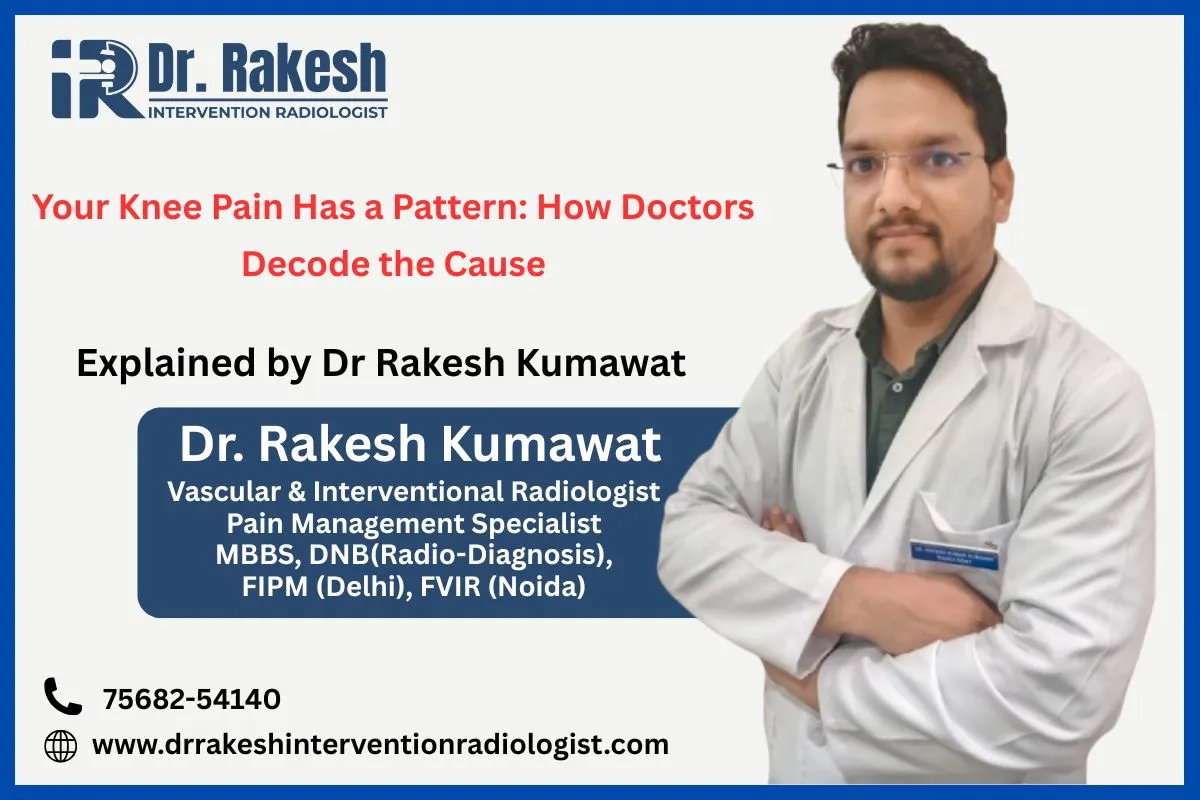
Your Knee Pain Has a Pattern: How Doctors Decode the Cause
Knee pain is one of the most common musculoskeletal complaints affecting people of all ages. While many assume it is simply a result of aging or overuse, knee pain often follows a distinct pattern that can reveal its underlying cause. The location of the pain, when it occurs, what triggers it, and how long it lasts all provide valuable clues that help doctors make an accurate diagnosis.
Rather than treating every patient with the same approach, specialists carefully evaluate these pain patterns to identify the root cause and recommend the most effective treatment. Dr. Rakesh Kumawat – Best Interventional Radiologist and Pain Management Specialist in Jaipur specializes in advanced, minimally invasive Knee Pain Treatment In Jaipur, helping patients regain mobility while avoiding unnecessary surgery whenever possible.
Why Knee Pain Should Never Be Ignored
Your knee is one of the most complex joints in the body. It bears your body weight while allowing you to walk, climb stairs, squat, and perform everyday activities. Persistent knee pain is often a sign that something is wrong within the joint, surrounding ligaments, cartilage, tendons, or blood supply.
Ignoring the pain may allow the condition to worsen, making treatment more difficult in the future.
The Pattern of Your Pain Matters
Doctors don’t diagnose knee pain based only on X-rays or MRI scans. They first understand how your pain behaves.
Questions commonly asked include:
- Where exactly is the pain located?
- Does it occur while walking or at rest?
- Is the pain sharp, dull, burning, or throbbing?
- Does it worsen while climbing stairs?
- Is there swelling or stiffness?
- Is the pain worse in the morning or after activity?
- Does the knee lock or give way?
- Is there clicking or grinding during movement?
These details often narrow down the possible causes before imaging is even performed.
Common Knee Pain Patterns and Their Meaning
Pain While Climbing or Descending Stairs
Pain during stair climbing often indicates cartilage wear, patellofemoral pain syndrome, or early osteoarthritis.
Morning Stiffness
If the knee feels stiff after waking up but improves with movement, osteoarthritis may be developing.
Pain After Walking Long Distances
Pain that gradually increases after prolonged walking may suggest degenerative arthritis or cartilage damage.
Swollen Knee with Warmth
Swelling accompanied by warmth may indicate inflammation, injury, or fluid accumulation that requires medical evaluation.
Sudden Sharp Pain
A sudden painful episode after twisting the knee could indicate a meniscus injury or ligament damage.
Constant Aching Even at Rest
Persistent pain even while resting often suggests advanced arthritis or chronic inflammation that requires specialist treatment.
Common Causes of Chronic Knee Pain
Several conditions can produce similar symptoms, making expert diagnosis essential.
These include:
- Osteoarthritis
- Rheumatoid arthritis
- Meniscus tears
- Ligament injuries
- Cartilage degeneration
- Patellar disorders
- Chronic inflammation
- Previous trauma
- Tendon disorders
Each condition requires a different treatment strategy.
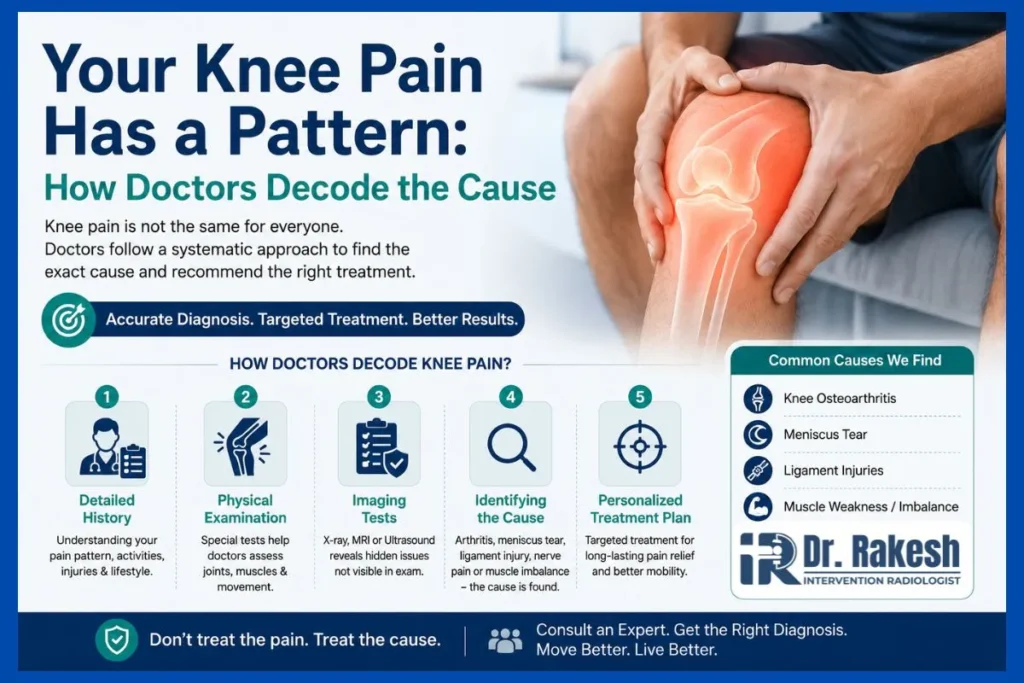
How Doctors Decode the Cause
Detailed Medical History
Understanding the onset, severity, duration, and pattern of symptoms provides the first diagnostic clues.
Physical Examination
Doctors evaluate:
- Joint movement
- Tenderness
- Swelling
- Stability
- Walking pattern
- Muscle strength
Imaging Studies
Depending on the suspected cause, investigations may include:
- X-rays
- MRI scans
- Ultrasound
- CT scans (when necessary)
Diagnostic Image-Guided Procedures
In selected patients, image-guided diagnostic injections help determine whether a specific nerve or joint compartment is responsible for the pain.
This precise approach allows personalized treatment planning.
Modern Non-Surgical Treatments for Knee Pain
Advances in interventional radiology now offer highly effective treatments without the need for major surgery in many patients.
Genicular Nerve Block
A Genicular Nerve Block Treatment In Jaipur is a minimally invasive procedure used to identify and temporarily interrupt pain signals from the nerves supplying the knee joint.
Under imaging guidance, a small amount of local anesthetic is injected near the genicular nerves.
Benefits include:
- Rapid pain relief
- Improved mobility
- Confirmation of pain source
- Minimal recovery time
- Helpful before considering nerve ablation
For many patients, this procedure provides both diagnostic information and significant symptom relief.
Genicular Nerve Ablation
If a patient experiences good relief from a Genicular Nerve Block, Genicular Nerve Ablation may be recommended.
This procedure uses radiofrequency energy to safely deactivate the pain-transmitting genicular nerves without affecting muscle function.
Advantages include:
- Long-lasting pain relief
- Reduced dependence on pain medications
- Improved walking ability
- Better quality of life
- Outpatient procedure with quick recovery
It is especially beneficial for patients with chronic knee osteoarthritis who wish to delay or avoid knee replacement surgery.
Genicular Artery Embolization (GAE)
One of the latest innovations in treating knee osteoarthritis is Genicular Artery Embolization Doctor In Jaipur (GAE).
Inflamed blood vessels around arthritic knees contribute significantly to chronic pain. During GAE, an interventional radiologist selectively blocks these abnormal vessels using tiny embolic particles.
Potential benefits include:
- Reduced inflammation
- Significant pain reduction
- Improved joint function
- No large surgical incision
- Faster recovery compared to surgery
- Preservation of the natural knee joint
GAE is becoming an excellent option for carefully selected patients with moderate to severe osteoarthritis.
PRP Therapy for Knee Pain
Platelet-Rich Plasma (PRP) Therapy uses the patient’s own blood to promote natural tissue healing.
After processing the blood, concentrated platelets rich in growth factors are injected into the affected knee under image guidance.
PRP Therapy may help:
- Reduce inflammation
- Promote tissue repair
- Improve joint function
- Delay disease progression
- Reduce chronic pain naturally
It is particularly useful for early osteoarthritis, ligament injuries, tendon disorders, and selected cartilage problems.
Why Personalized Treatment Works Better
Every patient’s knee pain is different. Two people with similar X-ray findings may require completely different treatments depending on their symptoms, activity level, and overall health.
Rather than relying solely on painkillers, personalized minimally invasive procedures target the actual source of pain, leading to better long-term outcomes.
Expert Knee Pain Care in Jaipur
If your knee pain is affecting your daily activities, early diagnosis is the key to successful treatment. Dr. Rakesh Kumawat – Best Interventional Radiologist and Pain Management Specialist Doctor In Jaipur offers comprehensive evaluation and advanced image-guided treatments including Genicular Nerve Block, Genicular Nerve Ablation, Genicular Artery Embolization (GAE), and PRP Therapy. These minimally invasive procedures help many patients reduce pain, improve mobility, and avoid major surgery.
Conclusion
Knee pain always tells a story. The timing, location, intensity, and triggers create a pattern that experienced specialists use to identify the underlying cause. Understanding this pattern allows doctors to provide precise, personalized treatment rather than temporary symptom relief.
With today’s advanced minimally invasive options—including Genicular Nerve Block, Genicular Nerve Ablation, Genicular Artery Embolization, and PRP Therapy—many patients can enjoy lasting pain relief without undergoing knee replacement surgery.
Frequently Asked Questions (FAQs)
1. Why does my knee pain worsen while climbing stairs?
This often indicates cartilage wear, patellofemoral pain syndrome, or early osteoarthritis, although a proper examination is needed for confirmation.
2. What is a Genicular Nerve Block?
It is an image-guided injection that temporarily blocks pain signals from the nerves around the knee to both diagnose and relieve chronic knee pain.
3. How is Genicular Nerve Ablation different from a nerve block?
A nerve block provides temporary relief, while Genicular Nerve Ablation uses radiofrequency energy to provide longer-lasting pain control by disrupting pain-transmitting nerves.
4. What is Genicular Artery Embolization (GAE)?
GAE is a minimally invasive procedure that reduces abnormal blood flow and inflammation around the knee joint, helping relieve osteoarthritis-related pain.
5. Who is a good candidate for GAE?
Patients with moderate to severe knee osteoarthritis who have persistent pain despite medications or physiotherapy and want to avoid or delay surgery may be suitable candidates.
6. What is PRP Therapy for knee pain?
PRP Therapy uses concentrated platelets from your own blood to promote healing, reduce inflammation, and improve joint function.
7. Can these treatments help avoid knee replacement surgery?
In many carefully selected patients, minimally invasive procedures can significantly reduce pain and improve function, delaying or even avoiding knee replacement.
8. Are these procedures painful?
Most are performed under local anesthesia with imaging guidance, involve minimal discomfort, and allow patients to return home the same day.
9. How do doctors determine which treatment is right for me?
They assess your symptoms, physical examination, imaging findings, medical history, and response to diagnostic procedures before recommending a personalized treatment plan.
10. Who should I consult for advanced knee pain treatment in Jaipur?
For comprehensive diagnosis and minimally invasive knee pain management, many patients consult Dr. Rakesh Kumawat – Best Interventional Radiologist and Pain Management Specialist in Jaipur, who offers advanced procedures such as Genicular Nerve Block Treatment In Jaipur, Genicular Nerve Ablation, Genicular Artery Embolization, and PRP Therapy.