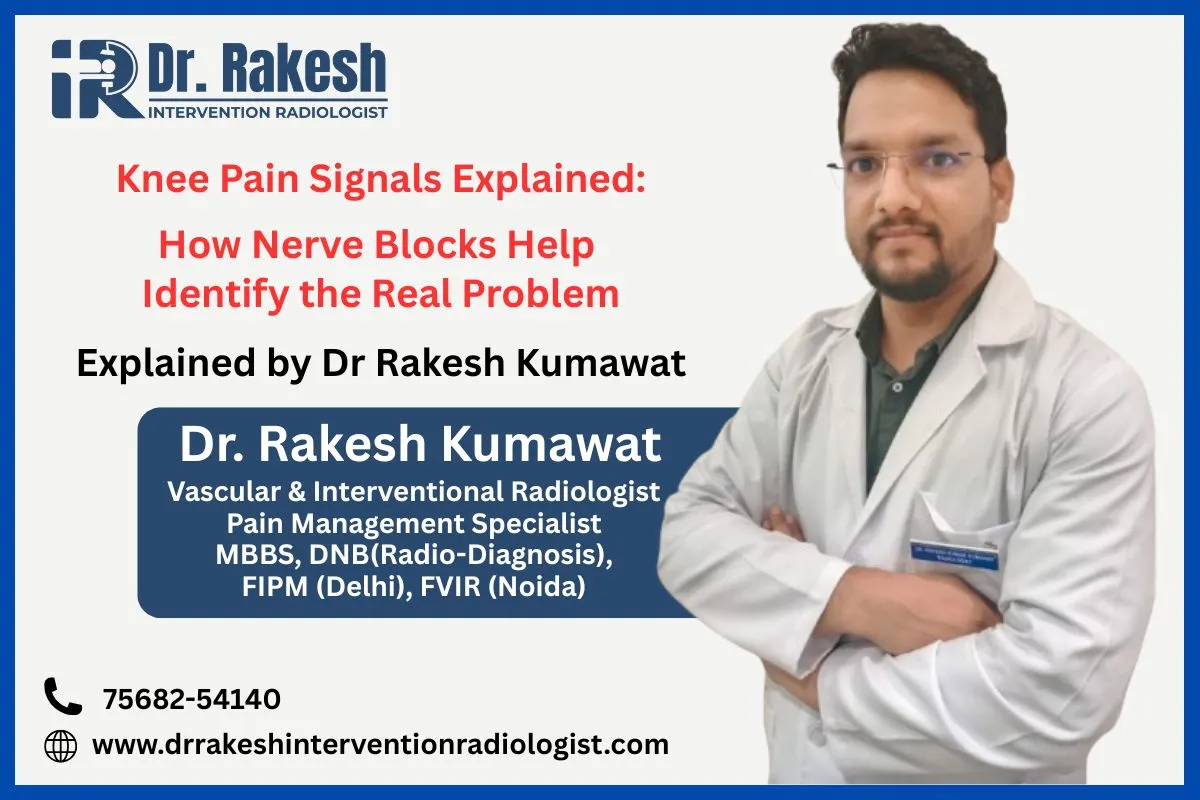
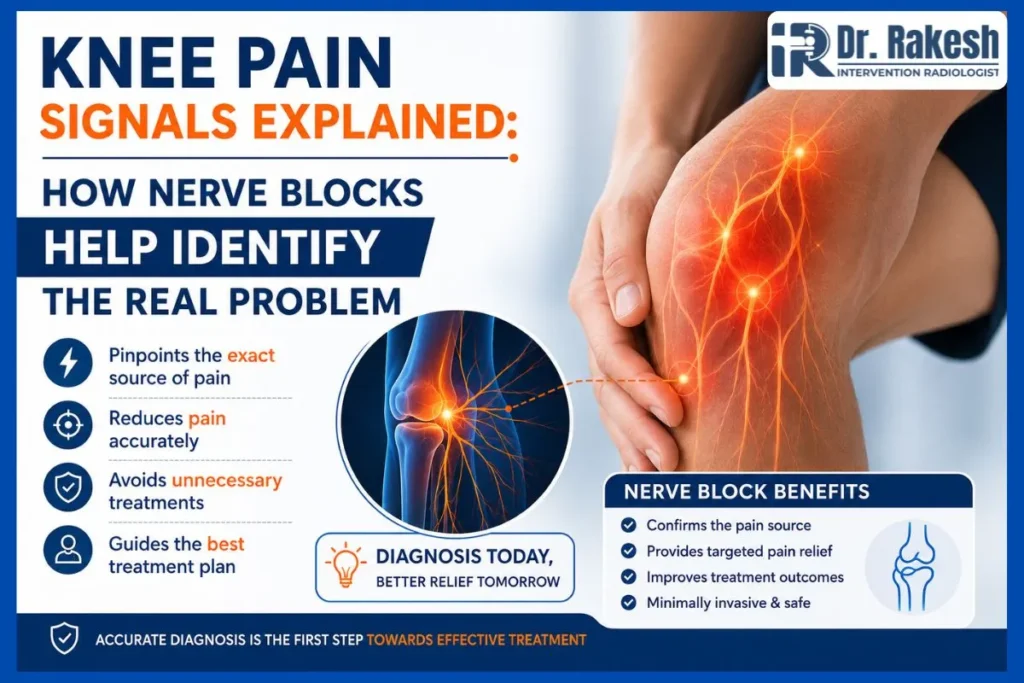
Knee Pain Signals Explained: How Nerve Blocks Help Identify the Real Problem
Knee pain is not always as simple as “joint pain.” In many patients, the pain may come from arthritis, cartilage wear, ligament injury, inflammation, muscle weakness, or irritated nerves around the knee. This is why two patients with similar X-ray reports may feel very different levels of pain. One person may walk comfortably, while another may struggle with stairs, standing, or daily movement.
To treat knee pain properly, doctors first need to understand where the pain signal is coming from. One important method used in advanced pain management is a nerve block, especially a genicular nerve block. Dr. Rakesh Kumawat, Best Interventional Radiologist and Pain Management Specialist in Jaipur, provides image-guided treatment options for patients suffering from chronic knee pain, arthritis pain, and nerve-related pain conditions.
What Are Knee Pain Signals?
Pain signals are messages sent from the knee to the brain through nerves. When the knee joint is damaged, inflamed, or irritated, the surrounding nerves become active and carry pain signals. The brain then reads these signals as pain.
In chronic knee pain, these signals may continue for a long time. Even simple activities like walking, bending, climbing stairs, or getting up from a chair can trigger pain. This is why identifying the pain pathway is important before choosing treatment.
Why Does Knee Pain Continue Even After Medicines?
Medicines may reduce inflammation or pain temporarily, but they may not always identify the real source. If the pain is mainly travelling through specific nerves, tablets may provide only short-term relief. Similarly, if inflammation around the joint is the major issue, a different treatment approach may be needed.
This is why a pain specialist evaluates the patient carefully before suggesting advanced procedures like genicular nerve block, genicular nerve ablation, PRP therapy, or genicular artery embolization.
What Is a Genicular Nerve Block?
A genicular nerve block is an injection-based procedure used to target selected nerves around the knee joint. These nerves, called genicular nerves, carry pain signals from the knee to the brain.
During the procedure, medicine is injected near these nerves to temporarily block pain signals. If the patient feels significant relief after the block, it helps the doctor understand that the genicular nerves are contributing to the pain.
How Does a Nerve Block Help Identify the Real Problem?
A nerve block works like a diagnostic test as well as a pain-relief procedure. If pain reduces after the block, it means the targeted nerves are likely involved in the pain pathway. This helps the doctor plan the next step more accurately.
For example, if a patient gets good relief after genicular nerve block, genicular nerve ablation may be considered for longer-lasting pain control. If the pain is more related to inflammation, cartilage injury, or joint degeneration, treatments like PRP therapy or Genicular Artery Embolization Doctor In Jaipur may be discussed depending on the condition.
Genicular Nerve Ablation for Longer Pain Relief
Genicular nerve ablation is an advanced minimally invasive procedure used for selected patients with chronic knee pain. In this treatment, controlled heat energy is used to reduce pain signals from targeted genicular nerves.
It does not replace the knee joint or cure arthritis, but it may help reduce pain and improve daily comfort. Doctors often use genicular nerve block before ablation to check whether the patient is likely to benefit from this procedure.
PRP Therapy for Knee Pain
PRP therapy, or platelet-rich plasma therapy, uses the patient’s own blood. The blood is processed to concentrate platelets, and then the PRP is injected into the affected area. Platelets contain growth factors that may support healing and reduce inflammation in selected joint and soft tissue conditions.
PRP therapy may be considered in early arthritis, ligament strain, tendon injury, or soft tissue-related knee pain. It is not suitable for every patient, so proper diagnosis is important.
Genicular Artery Embolization for Arthritis Pain
Genicular artery embolization is an image-guided procedure used in selected patients with knee osteoarthritis pain. In some arthritis cases, abnormal blood flow around the knee lining may contribute to inflammation and pain.
During genicular artery embolization, tiny particles are used to reduce abnormal blood flow to the inflamed area. This may help reduce pain and swelling in suitable patients. It is different from nerve block because it targets inflammation-related blood flow rather than pain-carrying nerves.
Who Can Benefit from Nerve Blocks?
Nerve blocks may be helpful for patients with chronic knee pain, knee osteoarthritis, age-related knee pain, pain after knee surgery, or pain that does not improve with medicines and physiotherapy. They may also be considered for patients who are not ready for knee replacement or want to explore non-surgical pain relief options.
However, every knee pain case is different. The doctor must review symptoms, X-ray or MRI findings, walking difficulty, pain pattern, and medical history before deciding the right treatment.
Why Choose Dr. Rakesh Kumawat in Jaipur?
Dr. Rakesh Kumawat is known as the Best Interventional Radiologist and Pain Management Specialist Doctor In Jaipur. His expertise in image-guided procedures helps patients receive accurate diagnosis and targeted treatment for knee pain, nerve pain, vascular conditions, and chronic pain disorders.
For knee pain, his approach focuses on identifying the real pain source before choosing treatment. This helps patients avoid unnecessary procedures and receive a personalized pain management plan.
Conclusion
Knee pain signals can come from different sources, including nerves, inflammation, arthritis, injury, or joint degeneration. Nerve blocks help doctors understand whether the genicular nerves are playing a major role in pain. This makes treatment planning more accurate and patient-specific.
If you are suffering from chronic knee pain and want advanced non-surgical treatment options in Jaipur, consult Dr. Rakesh Kumawat, Best Interventional Radiologist and Pain Management Specialist in Jaipur, for expert evaluation and personalized care.
FAQs
1. What are knee pain signals?
Knee pain signals are messages carried by nerves from the knee joint to the brain when the joint is irritated, inflamed, or damaged.
2. What is a genicular nerve block?
A genicular nerve block is an injection procedure that targets nerves around the knee to temporarily reduce pain signals.
3. How does nerve block identify the real pain source?
If pain reduces after the block, it suggests that the targeted nerves are contributing to the patient’s knee pain.
4. Is genicular nerve block a surgery?
No, it is a minimally invasive injection-based procedure and does not involve major surgery.
5. What is genicular nerve ablation?
Genicular nerve ablation uses controlled heat energy to reduce pain signals from selected knee nerves for longer-lasting relief in suitable patients.
6. What is PRP therapy for knee pain?
PRP therapy uses concentrated platelets from the patient’s own blood to support healing and reduce inflammation in selected knee pain conditions.
7. What is genicular artery embolization?
Genicular artery embolization is an image-guided procedure that reduces abnormal blood flow and inflammation around the knee in selected arthritis patients.
8. Can knee pain be treated without replacement surgery?
Many patients can manage knee pain with non-surgical options like medicines, physiotherapy, PRP therapy, nerve blocks, ablation, or GAE, depending on the condition.
9. Who should consider nerve block for knee pain?
Patients with chronic Knee Pain Doctor In Jaipur, arthritis pain, or pain not improving with basic treatment may be considered after proper evaluation.
10. Who is the best doctor for knee pain treatment in Jaipur?
Dr. Rakesh Kumawat, Best Interventional Radiologist and Pain Management Specialist in Jaipur, provides advanced image-guided treatment for chronic knee pain.