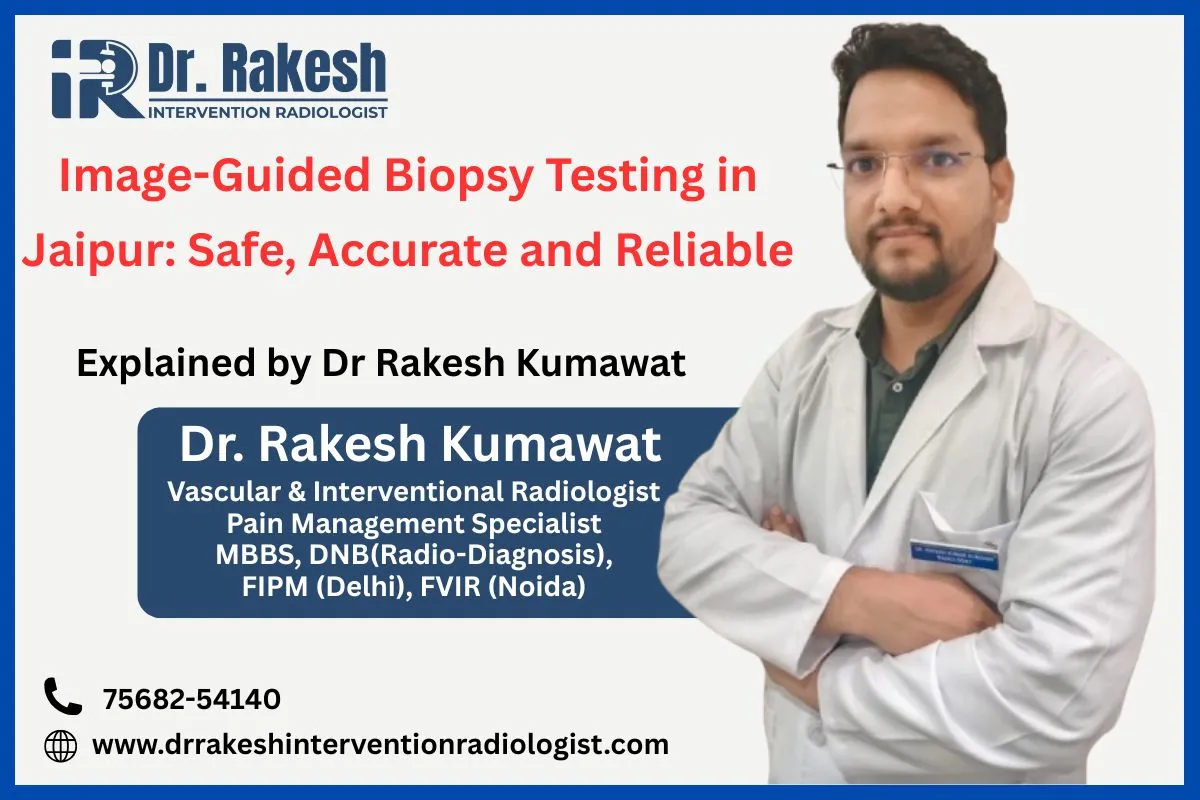
Image-Guided Biopsy Testing in Jaipur: Safe, Accurate and Reliable
When a doctor recommends a biopsy test, many patients feel anxious. The word “biopsy” often creates fear, but it is important to understand that a biopsy does not always mean cancer. It is a diagnostic procedure used to identify the exact nature of a lump, swelling, abnormal tissue, or suspicious finding seen in a scan.
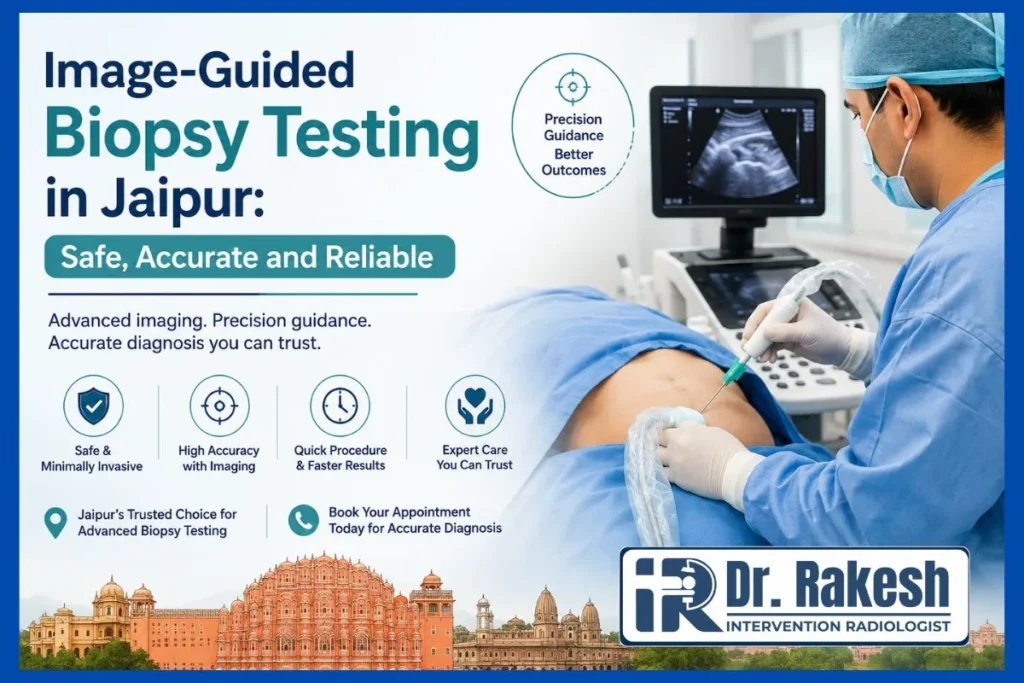
Image-guided biopsy is an advanced method that helps doctors collect samples from the correct location with better accuracy. Instead of relying only on touch or surface examination, the doctor uses imaging tools such as ultrasound, CT scan, MRI, or X-ray guidance to reach the target area safely.
Dr. Rakesh Kumawat, Best Interventional Radiologist and Pain Management Specialist in Jaipur, provides advanced image-guided diagnostic and interventional procedures for patients who need accurate diagnosis and safe testing.
What Is Image-Guided Biopsy?
Image-guided biopsy is a minimally invasive diagnostic procedure in which a small tissue or cell sample is collected from the body using imaging support. The collected sample is sent to a pathology lab, where it is examined under a microscope.
The main purpose is to help doctors understand whether the abnormal area is benign, infectious, inflammatory, precancerous, or cancerous. It helps avoid guesswork and supports proper treatment planning.
Why Is Image Guidance Important in Biopsy Testing?
In many cases, the abnormal area may be small, deep, or difficult to feel from outside. Without imaging support, it may be difficult to collect the sample from the exact location. Image guidance helps the doctor see the target area and guide the biopsy needle accurately.
This improves the chances of collecting a useful sample and reduces the risk of sampling from the wrong area. It is especially helpful for lesions in the breast, thyroid, lymph nodes, liver, kidney, lung, soft tissue, abdomen, and other deep locations.
When Do Doctors Recommend Image-Guided Biopsy?
Doctors may recommend image-guided biopsy when a scan shows an abnormal lump, growth, nodule, mass, or tissue change. It may also be advised when blood tests, ultrasound, CT scan, MRI, or physical examination do not provide a clear diagnosis.
Image-guided biopsy may be needed for thyroid nodules, breast lumps, enlarged lymph nodes, liver lesions, kidney lesions, lung nodules, soft tissue swellings, and suspicious deep-seated abnormalities. It helps doctors confirm the diagnosis before starting treatment.
Does Biopsy Always Mean Cancer?
No, biopsy does not always mean cancer. Many biopsy reports show non-cancerous conditions such as infection, inflammation, cysts, benign tumors, or tissue changes. Doctors recommend biopsy to confirm the diagnosis, not to create fear.
A timely biopsy can help patients get clarity. If the condition is minor, the report may reduce unnecessary worry. If the condition needs treatment, early diagnosis can help doctors plan the right care.
How Is Image-Guided Biopsy Done?
Before the procedure, the doctor reviews the patient’s symptoms, medical history, previous reports, and imaging findings. The patient may be asked about blood thinner medicines, allergies, diabetes, blood pressure, bleeding problems, or previous procedures.
During the biopsy, the patient is positioned according to the location of the target area. The skin is cleaned, and local anesthesia may be used to numb the area. Using ultrasound, CT, or another imaging method, the doctor guides the needle to the exact abnormal area and collects the sample.
After sample collection, a small dressing is applied. Most needle biopsy procedures are done as day-care procedures, depending on the patient’s condition and biopsy site.
Is Image-Guided Biopsy Painful?
Most patients feel only mild discomfort, pressure, or a small prick during the procedure. Local anesthesia helps reduce pain. After the procedure, mild soreness, bruising, swelling, or tenderness may occur at the biopsy site. These symptoms usually improve with simple care and doctor’s advice.
Patients should contact the doctor if they notice severe pain, increasing swelling, fever, redness, pus, or continuous bleeding.
Benefits of Image-Guided Biopsy
Image-guided Biopsy Testing Centre In Jaipur offers many benefits for suitable patients. It is minimally invasive, accurate, and usually avoids the need for open surgical biopsy. Because imaging helps guide the needle, the doctor can target the suspicious area more precisely.
It may also reduce unnecessary tissue injury, improve sample quality, and help doctors make faster treatment decisions. For patients, it can mean less discomfort, shorter procedure time, and quicker recovery compared to more invasive procedures.
How to Prepare for Image-Guided Biopsy
Preparation depends on the biopsy site and method. Patients should carry all previous reports, including ultrasound, CT scan, MRI, blood tests, FNAC reports, and doctor’s prescription. They should inform the doctor about blood thinners, allergies, pregnancy, diabetes, high blood pressure, or bleeding disorders.
Some biopsies may require fasting, while others do not. The doctor or diagnostic centre will give specific instructions before the procedure.
Why Choose Dr. Rakesh Kumawat in Jaipur?
Dr. Rakesh Kumawat is known as the Best Interventional Radiologist and Pain Management Specialist in Jaipur. His expertise in image-guided procedures helps patients receive accurate, safe, and targeted diagnostic care.
For biopsy testing, image guidance plays an important role in improving precision and patient comfort. Dr. Rakesh Kumawat focuses on proper evaluation, safe technique, and clear patient guidance before and after the procedure.
Conclusion
Image-guided biopsy testing is an advanced diagnostic method that helps doctors collect samples safely and accurately. It is useful when a lump, swelling, or abnormal scan finding needs proper confirmation. Most importantly, biopsy does not always mean cancer; it is a test that helps doctors reach the correct diagnosis.
If you are looking for image-guided Biopsy Testing Centre In Jaipur, consult Dr. Rakesh Kumawat, Best Interventional Radiologist and Pain Management Specialist in Jaipur, for expert evaluation and reliable diagnostic care.
FAQs
1. What is image-guided biopsy?
Image-guided biopsy is a procedure where ultrasound, CT, MRI, or X-ray guidance is used to collect a tissue or cell sample from the correct area.
2. Why do doctors recommend image-guided biopsy?
Doctors recommend it when a lump, swelling, or abnormal scan finding needs accurate diagnosis through tissue examination.
3. Does biopsy always mean cancer?
No, biopsy can also diagnose infection, inflammation, cysts, benign tumors, and other non-cancerous conditions.
4. Is image-guided biopsy painful?
Most patients feel mild discomfort or pressure. Local anesthesia is usually used to reduce pain.
5. Which body parts can be tested with image-guided biopsy?
It may be used for thyroid, breast, lymph nodes, liver, kidney, lung, soft tissue, abdomen, and other suspicious areas.
6. Is image-guided biopsy better than normal biopsy?
Image guidance improves accuracy, especially for small, deep, or difficult-to-feel lesions.
7. Can I go home after biopsy?
Most patients can go home the same day after a needle biopsy, unless observation is advised.
8. What are the risks of biopsy?
Minor risks may include soreness, bruising, swelling, bleeding, or infection. Serious complications are uncommon.
9. How long does biopsy report take?
Report timing depends on the sample type and lab process. It usually takes a few days.
10. Who is the best doctor for image-guided biopsy testing in Jaipur?
Dr. Rakesh Kumawat, Best Interventional Radiologist and Pain Management Specialist in Jaipur, provides advanced image-guided biopsy testing and diagnostic care.