

Biopsy Results Explained: What Benign, Suspicious and Malignant Findings Mean
Waiting for a biopsy result can be stressful, especially when the report contains unfamiliar medical terms. Words such as benign, suspicious, atypical, indeterminate, or malignant can create confusion if they are read without clinical context. A biopsy report, however, is not simply a “cancer or no cancer” document. It provides detailed information about the cells and tissue collected from an abnormal area.
Understanding what common biopsy results mean can help patients have a clearer conversation with their doctor and understand what may happen next. Patients looking for the Best Interventional Radiologist In Jaipur can discuss their biopsy findings and suitable image-guided diagnostic options with a specialist.
What Is a Biopsy?
A biopsy involves removing a small sample of tissue from a lump, organ, lymph node, or other abnormal area so it can be examined under a microscope by a pathologist.
Depending on the location and suspected condition, doctors may recommend a core needle biopsy, image-guided biopsy, surgical biopsy, or another sampling technique.
Ultrasound or CT guidance may be used to position the biopsy needle accurately, particularly when the abnormal area is small or located deep inside the body.
The collected tissue is then processed and examined for abnormal cellular and structural changes. A Biopsy Testing Centre In Jaipur may offer diagnostic sampling services depending on the facility and the type of test required.
What Does a Benign Biopsy Result Mean?
A benign biopsy result means that the tissue examined does not show cancer.
Benign findings can include normal tissue, inflammation, infection, cyst-related changes, fibrosis, or non-cancerous growths. The exact meaning depends on the organ and the abnormality being investigated.
A benign result is generally reassuring, but it does not always mean that no further follow-up is necessary.
Doctors usually compare the pathology result with imaging findings, symptoms, examination, and medical history. If a scan looks highly concerning but the biopsy appears benign, the healthcare team may investigate further to ensure that the sampled tissue accurately represents the abnormal area.
This process is often called radiologic-pathologic correlation.
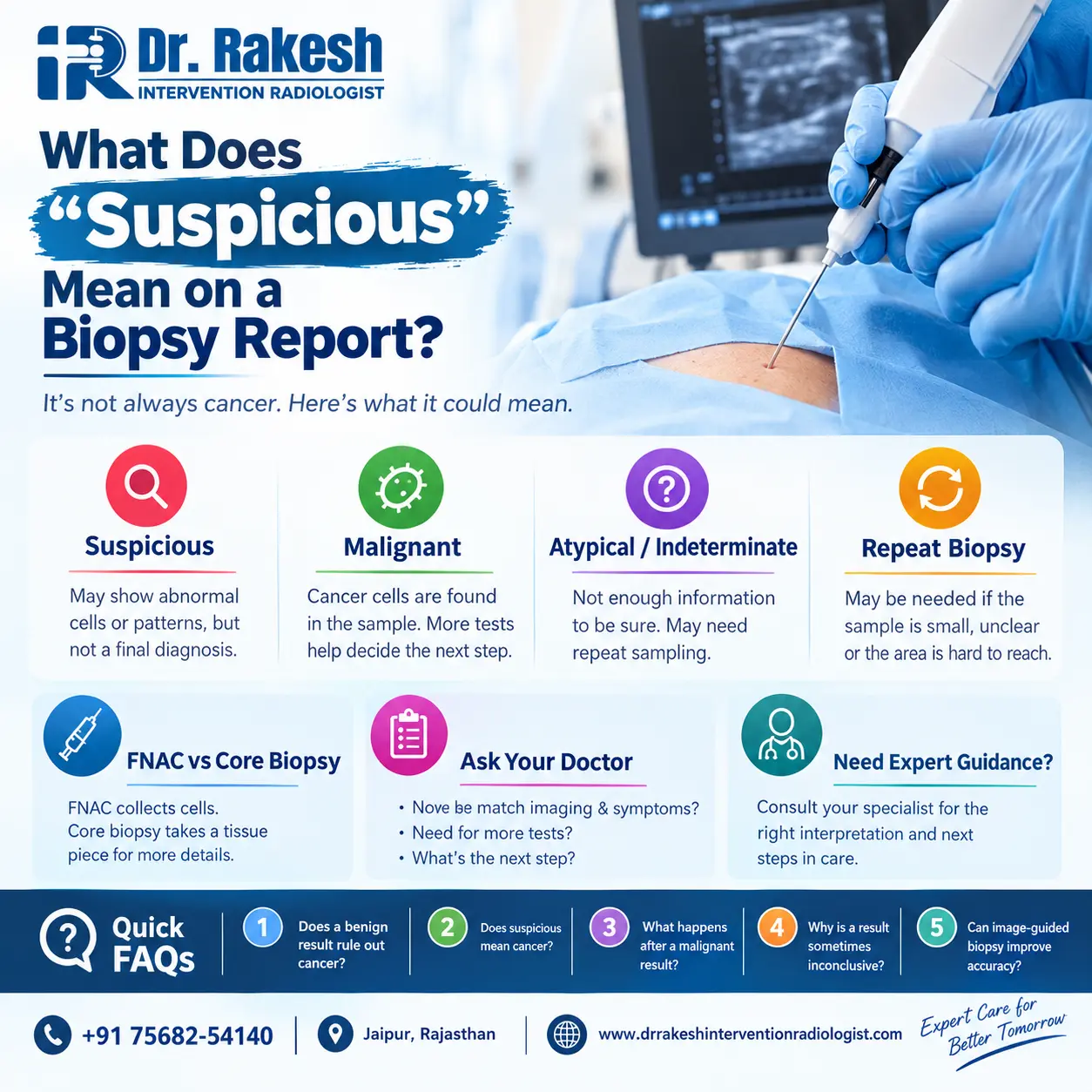
What Does “Suspicious” Mean on a Biopsy Report?
The word suspicious does not automatically mean cancer has been confirmed.
Sometimes the tissue sample contains abnormal cells or patterns that raise concern for malignancy, but there may not be enough evidence to make a definitive diagnosis.
A suspicious result may occur when the sample is small, tissue architecture is incomplete, or cellular changes fall between clearly benign and clearly malignant categories.
Depending on the situation, the doctor may recommend another biopsy, a larger tissue sample, additional laboratory testing, repeat imaging, or surgical evaluation.
Therefore, patients should avoid interpreting “suspicious” as a final cancer diagnosis without discussing the complete report with their treating specialist.
What Does a Malignant Biopsy Result Mean?
A malignant biopsy result means that cancer cells have been identified in the tissue sample.
The pathology report may provide additional information about the cancer type and characteristics. In certain cancers, further testing may determine tumor grade, biomarkers, receptors, molecular features, or other factors that help guide treatment.
A malignant result is an important diagnosis, but it is usually only one part of the overall assessment.
Doctors may recommend additional imaging, blood investigations, or other tests to determine the extent of disease and develop an appropriate treatment plan.
Treatment can vary considerably depending on the cancer type, location, stage, biological characteristics, and patient’s overall health.
What Are Atypical or Indeterminate Results?
Not every biopsy fits neatly into benign or malignant categories.
Terms such as atypical, indeterminate, inconclusive, or non-diagnostic may appear when the available sample does not provide enough information for a definite conclusion.
Atypical cells look different from normal cells but may not have all the characteristics required to diagnose cancer.
A non-diagnostic result may simply mean that insufficient representative tissue was obtained.
These findings can require repeat sampling or another diagnostic approach rather than immediate treatment.
Why Can a Repeat Biopsy Be Necessary?
Patients sometimes worry when their doctor recommends another biopsy. However, repeating the procedure does not necessarily mean cancer has been discovered.
A repeat biopsy may be required because the first sample was insufficient, the abnormal area was difficult to access, imaging and pathology findings do not match, or additional tissue is needed for specialized testing.
The objective is to obtain enough reliable information to make an accurate diagnosis. Patients considering Knee Pain Treatment In Jaipur should also understand that a biopsy may be recommended in selected cases when a lump, bone lesion, or other abnormality needs further evaluation; it is not a routine test for every case of knee pain.
FNAC vs Core Biopsy
Fine Needle Aspiration Cytology (FNAC) and core biopsy are both useful diagnostic techniques, but they collect different types of samples.
FNAC primarily collects individual cells or small cell groups. A core biopsy removes a narrow piece of tissue, allowing the pathologist to evaluate both cells and their surrounding tissue architecture.
The appropriate test depends on the location, type of lesion, imaging appearance, and clinical question.
What Should You Ask After Receiving Your Biopsy Report?
Instead of focusing only on a single word in the report, ask whether the pathology result matches the imaging findings and clinical picture.
Patients may also ask whether additional testing is necessary, whether follow-up imaging is recommended, and what the next step should be.
The final interpretation should combine pathology with the patient’s broader medical assessment. Consulting the Best Interventional Radiologist In Jaipur may help patients understand available image-guided diagnostic procedures when appropriate, alongside advice from the treating doctor and pathologist.
Frequently Asked Questions
1. Does a benign biopsy guarantee that I do not have cancer?
A benign result means cancer was not identified in the tissue examined. Doctors still consider whether the sample adequately represents the abnormality and whether the pathology matches imaging and clinical findings.
2. Does a suspicious biopsy mean cancer?
No. Suspicious means concerning abnormalities were identified, but the findings may not be sufficient for a definitive malignant diagnosis. Additional testing or repeat biopsy may be recommended.
3. What happens after a malignant biopsy result?
Your healthcare team may recommend further tests to characterize the cancer and determine its extent before discussing appropriate treatment options.
4. Why would my biopsy result be inconclusive?
The sample may contain insufficient tissue, may not adequately represent the targeted lesion, or may show changes that cannot confidently be classified.
5. Can an image-guided biopsy improve sampling accuracy?
Ultrasound or CT guidance can help doctors accurately target visible abnormalities, especially those that are small or located deeper within the body, improving the likelihood of obtaining representative tissue.