
Laser vs Traditional Varicose Vein Surgery: How Are They Different?
Varicose veins are enlarged, twisted veins that commonly appear in the legs when the valves responsible for directing blood toward the heart stop functioning effectively. For some people, they are mainly a cosmetic concern. For others, varicose veins can cause pain, heaviness, swelling, itching, cramps, skin pigmentation, and other symptoms of chronic venous insufficiency.
In the past, traditional surgical procedures such as vein ligation and stripping were commonly used to treat problematic veins. Today, many suitable patients can be treated using minimally invasive techniques such as Endovenous Laser Treatment (EVLT/EVLA).
Both approaches aim to manage abnormal veins, but the way they are performed, recovery experience, and patient selection can be quite different. A Vein Specialist Doctor In Jaipur can help patients understand these treatment options after evaluating their symptoms and venous circulation.
Why Do Varicose Veins Need Treatment?
Healthy leg veins contain one-way valves that prevent blood from flowing backward. When these valves become weak or damaged, blood can reflux and collect inside superficial veins.
This condition is called venous reflux.
Over time, increased venous pressure can lead to enlarged varicose veins and symptoms such as aching, heaviness, swelling, burning, itching, night cramps, or skin changes around the ankles.
Treatment may be considered when symptoms become troublesome or complications develop.
What Is Traditional Varicose Vein Surgery?
Traditional vein surgery generally involves procedures such as ligation and stripping.
During vein stripping, the problematic superficial vein is surgically tied off and removed through incisions. The exact technique varies according to the veins involved and the patient’s anatomy.
Traditional surgery has been used successfully for many years and may still have a role in selected patients.
However, because veins are physically accessed and removed, the procedure generally involves more surgical tissue manipulation than catheter-based endovenous treatment. A Varicose Vein Surgeon In Jaipur can assess whether traditional surgery or a minimally invasive alternative is appropriate for an individual patient.
What Is Endovenous Laser Treatment?
Endovenous Laser Treatment, commonly called EVLT or EVLA, treats a refluxing vein from inside rather than surgically stripping it out.
Under ultrasound guidance, a thin laser fibre is inserted into the abnormal vein through a small skin puncture. The fibre is carefully positioned along the targeted section of the vein.
Laser energy is then delivered as the fibre is withdrawn. This produces controlled thermal injury to the vein wall, causing the vein to close.
The body gradually deals with the treated vein while blood is redirected through other functioning veins.
Laser Treatment vs Surgery: What Is the Main Difference?
The biggest difference is how the abnormal vein is treated.
Traditional surgery generally removes or surgically disconnects the problematic vein. Endovenous laser therapy closes the abnormal vein from within using a catheter-based technique.
Because EVLT is performed through a small access point, it usually avoids the larger incisions associated with traditional stripping.
However, “minimally invasive” does not mean completely risk-free. Both procedures require proper evaluation and appropriate patient selection.
What About Anesthesia?
The type of anesthesia used depends on the procedure, patient, treatment extent, and healthcare setting.
Traditional vein stripping may require regional or general anesthesia in some circumstances.
Endovenous laser treatment is often performed using local or tumescent anesthesia around the treated vein. This solution helps provide anesthesia and separates the vein from surrounding tissues during laser treatment.
Patients should discuss the planned anesthesia with their treating specialist.
Is Recovery Different?
Recovery can be an important consideration when comparing treatments.
After traditional surgery, patients may experience bruising, discomfort, and recovery related to the surgical incisions and vein removal.
Following uncomplicated EVLT, many patients are encouraged to walk soon after treatment and may return to routine activities relatively quickly. Recovery time varies according to the number and size of veins treated, additional procedures performed, and individual healing.
Patients should follow their specialist’s instructions rather than using another person’s recovery experience as a guide.
Why Is Colour Doppler Important Before Treatment?
Choosing between laser treatment, surgery, or another technique should not be based solely on visible veins.
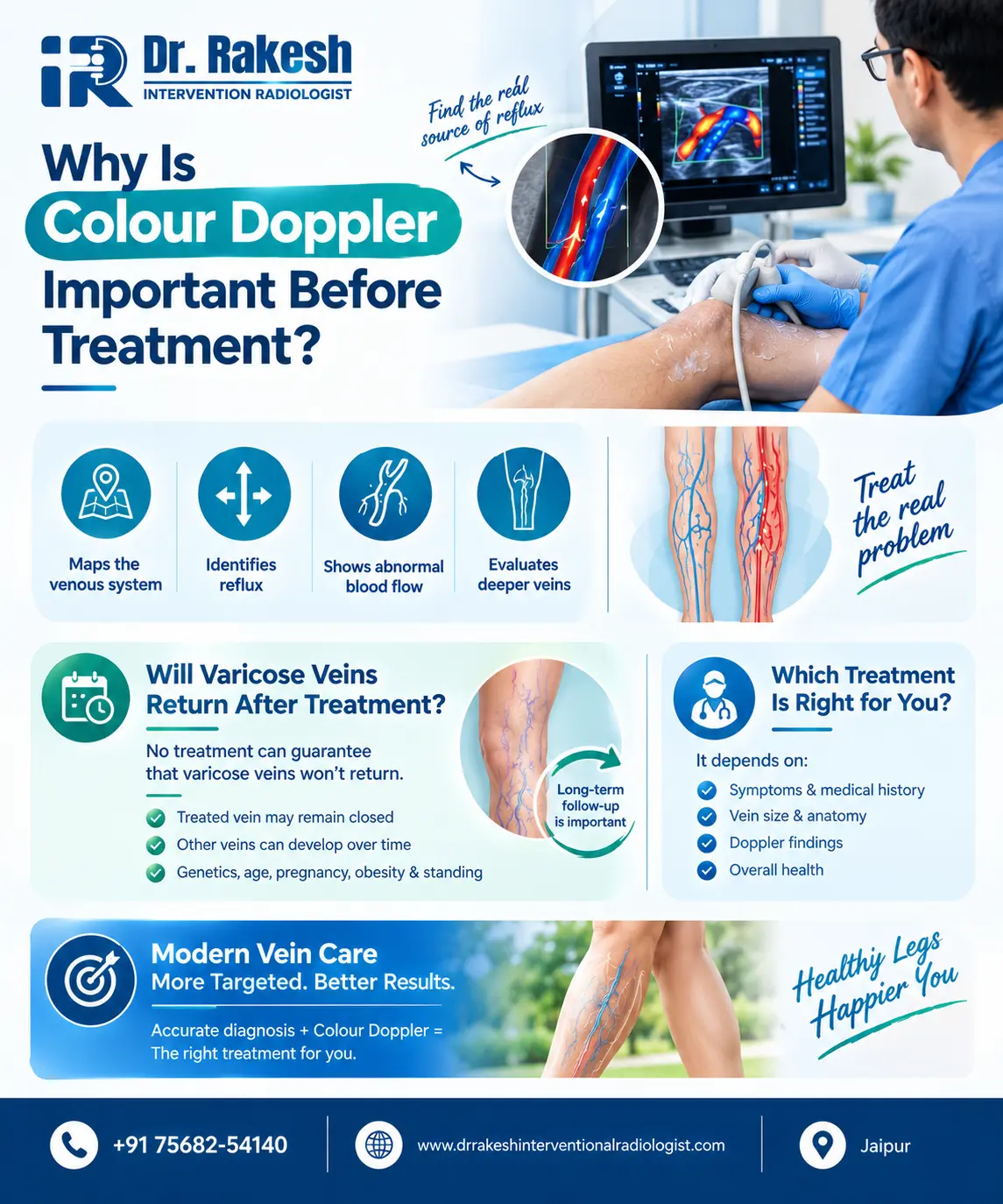
A Colour Doppler ultrasound can map the venous system and identify the actual source of reflux. It can show which veins have abnormal backward blood flow and help evaluate deeper veins.
This information allows treatment to focus on the underlying venous problem instead of simply treating visible surface veins.
Accurate Doppler mapping is therefore an important part of modern varicose vein treatment planning. Patients considering Varicose Vein Laser Treatment In Jaipur should undergo an appropriate clinical assessment and Colour Doppler evaluation to help determine whether laser treatment is suitable.
Does Laser Treatment Guarantee Varicose Veins Will Never Return?
No varicose vein treatment can guarantee that a patient will never develop another abnormal vein.
A successfully treated vein may remain closed, but venous disease can progress in other veins over time. Occasionally, a treated vein may also reopen.
Genetics, age, pregnancy, obesity, prolonged standing, and progression of venous valve dysfunction can contribute to future varicose veins.
This is why follow-up and long-term vein care remain important.
Which Varicose Vein Treatment Is Right for You?
There is no single treatment that is appropriate for every patient.
Endovenous laser therapy is commonly considered for suitable refluxing superficial veins because it offers a minimally invasive approach without traditional vein stripping. However, anatomy, vein size, previous procedures, symptoms, Doppler findings, and overall medical condition can influence treatment selection.
Some patients may require additional treatments for visible branch veins even after the main refluxing vein has been treated.
The most appropriate approach should therefore be determined after clinical examination and Colour Doppler evaluation.
Modern Varicose Vein Care Is Becoming More Targeted
The transition from traditional surgery toward minimally invasive treatment reflects a broader change in medicine: treating the underlying problem with greater precision while minimizing unnecessary tissue disruption whenever possible.
EVLT provides an important modern option for selected patients, but successful varicose vein management begins with accurate diagnosis—not simply choosing between “laser” and “surgery.”
Understanding where reflux originates is the first step toward creating an individualized treatment plan.
Frequently Asked Questions
1. Is laser treatment better than traditional varicose vein surgery?
Both are established treatment approaches. The appropriate option depends on vein anatomy, Doppler findings, symptoms, previous treatments, and individual health factors.
2. Are varicose veins removed during EVLT?
No. EVLT closes the abnormal vein from inside. The treated vein is gradually managed by the body while blood flows through other functioning veins.
3. Can I walk after varicose vein laser treatment?
Walking is commonly encouraged soon after uncomplicated endovenous laser treatment, although individual post-procedure instructions should always be followed.
4. Can varicose veins return after laser treatment?
Yes. The treated vein may remain closed while new reflux develops elsewhere, and occasionally a treated vein can reopen. Follow-up helps identify recurrence.
5. Do I need Colour Doppler before varicose vein treatment?
Colour Doppler is commonly an important part of evaluation because it identifies venous reflux, maps abnormal veins, and helps specialists plan treatment according to the underlying circulation problem.