Knee Pain That Doesn’t Improve with Medicines: Is GAE the Next Step?
Knee Pain Treatment In Jaipur is a common problem, especially in people with arthritis, age-related joint changes, obesity, previous injury, or long-term wear and tear. Many patients start treatment with painkillers, anti-inflammatory medicines, physiotherapy, exercise, and lifestyle changes. These options can help in many cases, but some patients continue to suffer from knee pain even after trying medicines for a long time.
When knee pain does not improve with medicines, patients often wonder what to do next. Should they continue taking painkillers? Should they consider injections? Is knee replacement the only option? For selected patients with knee osteoarthritis pain, an advanced minimally invasive procedure called Genicular Artery Embolization, or GAE, may be considered.
Dr. Rakesh Kumawat, Best Interventional Radiologist and Pain Management Specialist in Jaipur, provides advanced image-guided treatment options for chronic knee pain and other pain-related conditions.
Why Knee Pain May Not Improve with Medicines
Medicines can reduce pain and inflammation temporarily, but they may not always treat the actual cause of chronic knee pain. In knee osteoarthritis, the joint lining may remain inflamed, cartilage may be damaged, and abnormal pain signals may continue even after taking tablets.
Some patients also cannot take painkillers for a long time because of acidity, kidney problems, blood pressure, diabetes, heart issues, or other medical conditions. In such cases, repeatedly depending on medicines may not be the best long-term solution.
That is why proper evaluation by a pain management specialist is important when knee pain becomes persistent.
What Is Genicular Artery Embolization?
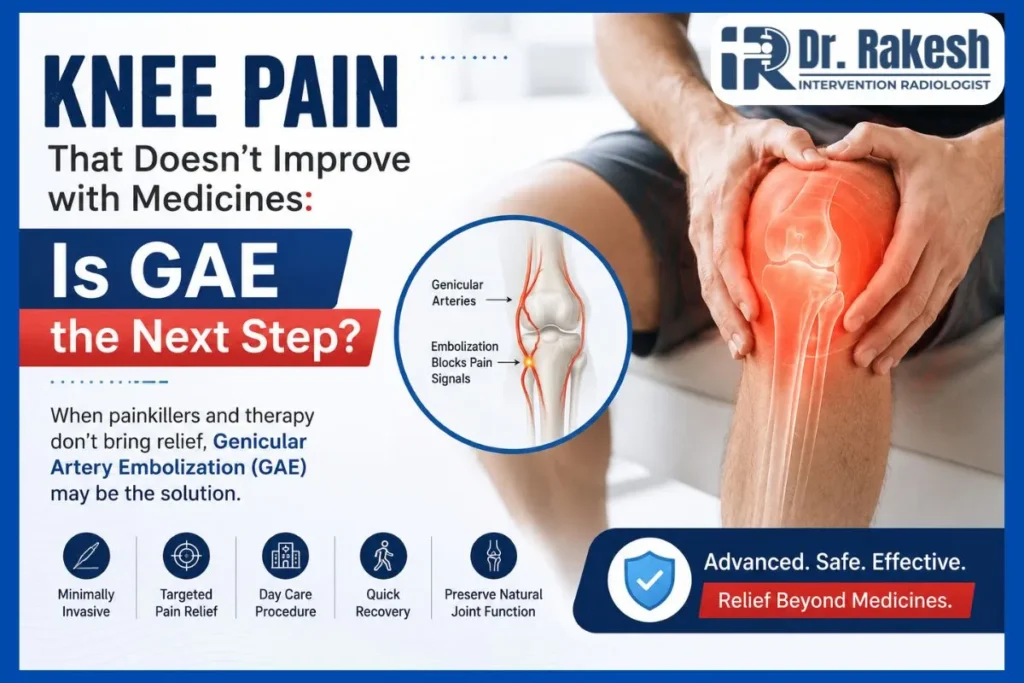
Genicular Artery Embolization Doctor In Jaipur, commonly called GAE, is a minimally invasive image-guided procedure used in selected patients with knee osteoarthritis pain. The genicular arteries are small blood vessels around the knee. In arthritis, abnormal blood flow and inflammation around the joint lining may contribute to pain and swelling.
During GAE, the doctor uses imaging guidance to reach the targeted blood vessels and injects tiny particles to reduce abnormal blood flow to the inflamed area. By reducing this inflammation-related blood supply, GAE may help reduce pain and improve knee comfort in suitable patients.
Is GAE a Surgery?
No, GAE is not a major surgery. It is a minimally invasive interventional radiology procedure. It does not involve knee replacement, large cuts, or removal of the joint.
The procedure is usually performed through a small puncture, commonly near the groin or wrist area, depending on the doctor’s approach. A thin catheter is guided through the blood vessels toward the knee. Since imaging is used during the procedure, the treatment can be targeted more precisely.
Who May Benefit from GAE?
GAE may be considered for patients with chronic knee osteoarthritis pain who do not get enough relief from medicines, physiotherapy, weight management, or basic injections. It may also be suitable for patients who want to delay knee replacement or are not medically fit for major surgery.
However, GAE is not for every type of knee pain. If pain is due to ligament tear, meniscus injury, infection, fracture, or severe joint destruction, another treatment may be needed. A detailed evaluation, imaging, and medical history review are necessary before deciding if GAE is the right option.
GAE vs Painkillers: What Is the Difference?
Painkillers usually work by reducing pain sensation or inflammation temporarily. They may help during flare-ups but may not provide long-term control for every patient.
GAE works differently. It targets abnormal blood flow linked with inflammation around the knee joint. Instead of only masking pain, it aims to reduce one possible source of arthritis-related knee pain. This is why doctors may consider GAE when conservative treatments are not giving enough relief.
What Happens Before GAE?
Before planning GAE, the doctor evaluates the patient’s symptoms, X-ray or MRI findings, arthritis stage, walking difficulty, swelling, previous treatments, and overall health. Blood tests and vascular assessment may also be advised.
The doctor checks whether the knee pain pattern matches osteoarthritis-related inflammation and whether the patient is a suitable candidate for image-guided embolization.
What Happens After the Procedure?
After GAE, patients are usually observed for some time. Mild soreness, temporary skin color changes, bruising, or discomfort may occur in some cases. The doctor gives instructions about walking, medicines, follow-up, and activity level.
Pain relief may not always be immediate. Some patients may notice gradual improvement over weeks as inflammation reduces. Results can vary from patient to patient, so follow-up is important.
Why Choose Dr. Rakesh Kumawat in Jaipur?
Dr. Rakesh Kumawat is known as the Best Interventional Radiologist and Pain Management Specialist Doctor In Jaipur. His experience in image-guided procedures helps patients receive targeted treatment for chronic knee pain, arthritis pain, nerve pain, vascular conditions, and other pain-related problems.
For knee pain that does not improve with medicines, he focuses on proper diagnosis and personalized treatment planning. GAE may be suggested only when it matches the patient’s condition and treatment goals.
Conclusion
Knee pain that does not improve with medicines should not be ignored. It may be a sign that the condition needs deeper evaluation and a more targeted treatment plan. For selected patients with knee osteoarthritis pain, Genicular Artery Embolization may be an advanced non-surgical option.
If you are suffering from chronic knee pain and want to explore treatment beyond medicines, consult Dr. Rakesh Kumawat, Best Interventional Radiologist and Pain Management Specialist in Jaipur, for expert evaluation and advanced pain management options.
FAQs
1. What is GAE for knee pain?
GAE, or Genicular Artery Embolization, is a minimally invasive procedure that targets abnormal blood vessels around the knee to reduce arthritis-related inflammation and pain.
2. Is GAE a knee replacement surgery?
No, GAE is not knee replacement. It is a non-surgical image-guided procedure performed through a small puncture.
3. Who is suitable for GAE?
Patients with knee osteoarthritis pain who do not improve with medicines, physiotherapy, or basic injections may be considered after proper evaluation.
4. Can GAE cure knee arthritis?
GAE does not cure arthritis or rebuild cartilage. It may help reduce pain and inflammation in selected patients.
5. Is GAE painful?
Most patients experience only mild discomfort during or after the procedure. The doctor may use local anesthesia and image guidance.
6. How soon can pain improve after GAE?
Pain relief may develop gradually over weeks. Results vary depending on the patient’s arthritis stage and overall condition.
7. Can GAE delay knee replacement?
In selected patients, GAE may help manage pain and delay surgery, but it does not replace knee replacement when joint damage is severe.
8. Is GAE better than painkillers?
GAE works differently from painkillers. Painkillers provide temporary relief, while GAE targets inflammation-related abnormal blood flow in selected arthritis cases.
9. Are there risks with GAE?
Like any procedure, GAE may have minor risks such as bruising, soreness, temporary skin changes, or discomfort. Suitability should be assessed by a specialist.
10. Who is the best doctor for GAE in Jaipur?
Dr. Rakesh Kumawat, Best Interventional Radiologist in Jaipur and Pain Management Specialist, provides advanced image-guided treatment options for chronic knee pain.